
CoupModel
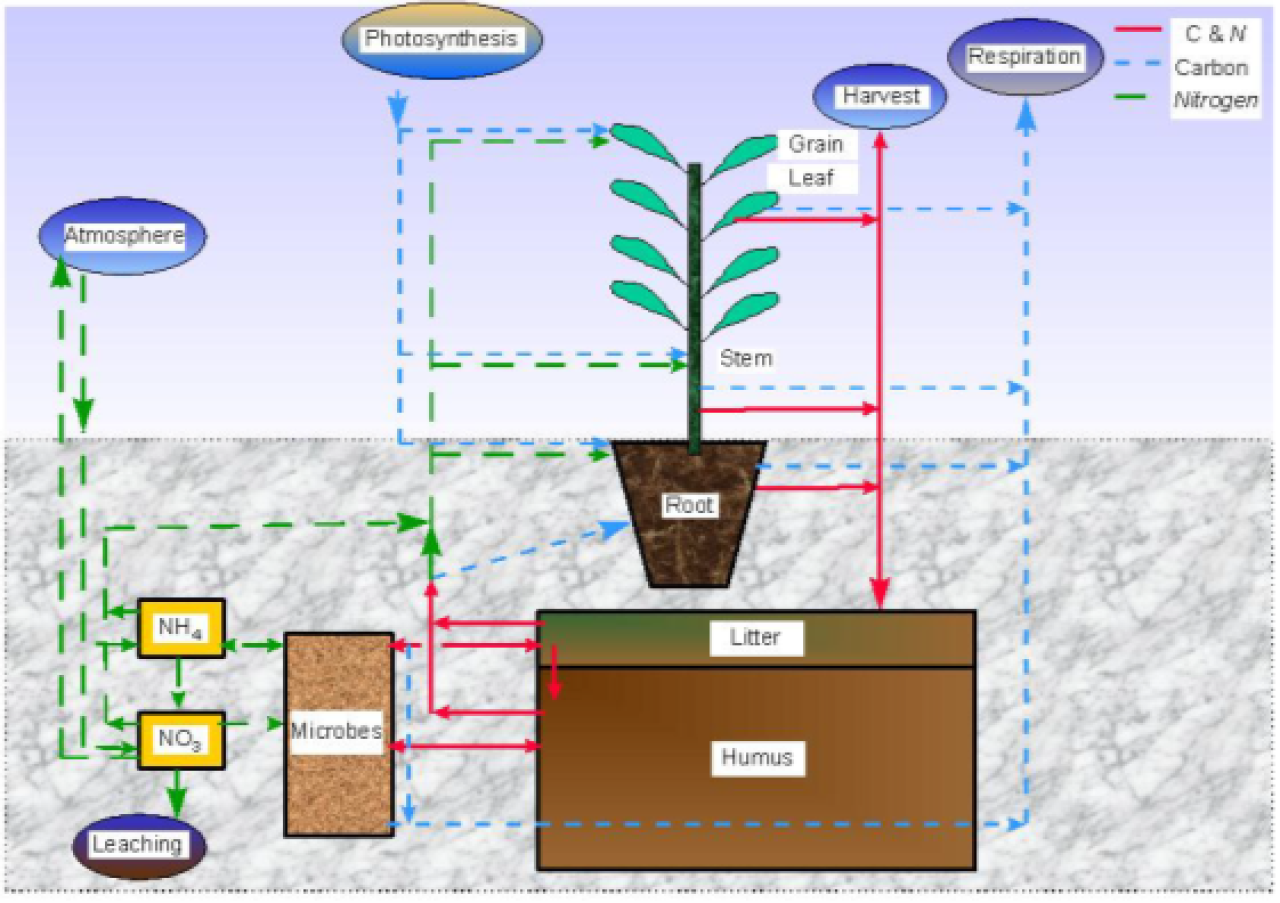
CoupModel-skjema for karbon- og nitrogenstrømmer og lagring. Kilde: https://www.coupmodel.com/
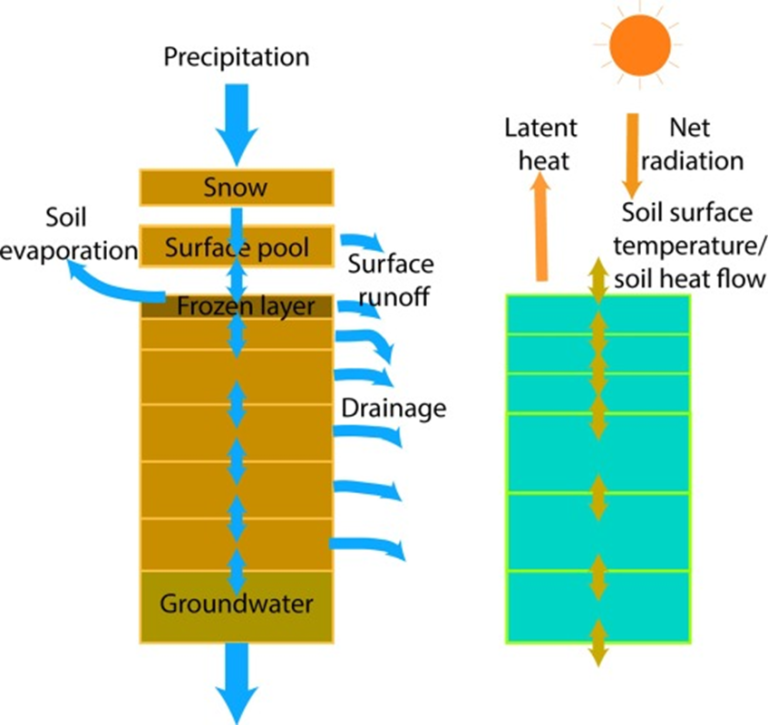
CoupModel er en simuleringsplattform utviklet for å modellere koblede prosesser for varme, vann, karbon og næringsstoffer i jord–plante–atmosfære-systemet. Den benytter fysiske prinsipper som bevaring av masse og energi for å beskrive prosesser som vanntransport i jord (via Richards’ ligning), varmetransport (via Fouriers lov), snøsmelting, evapotranspirasjon og plantevekst. Modellen integrerer biogeokjemiske kretsløp – karbon, nitrogen og fosfor – og gjør det mulig å studere samspillet mellom klima, jordegenskaper og vegetasjon over tidsskalaer fra minutter til århundrer.
Navn på modell | CoupModel | ||
Om modellen |
| ||
Formål med modellen |
| ||
Utvilker | Per-Erik Jansson | ||
Skala |
| ||
Romlig | Fra lokal skala til landskap | ||
Tidsmessig | Sub-daglig til daglig | ||
Prosessbeskrivelse |
| ||
Modelltype | Prosessbasert | Varme | Ja |
Intersepsjon | Ja | Snødynamikk | Ja |
Infiltrasjon og vanntransport | Ja | Frossen jord | Ja |
Overflateavrenning | Ja, som en lineær funksjon av overflatevann | Plantevekst | Ja, 1) logistisk vekst, 2) WUE/LUE, 3) Farquhar-tilnærming |
Makroporestrømming | Ja | Nitrogentransport | Ja |
Evapotranspirasjon | Ja, 1) enkel løvtak, 2) flere løvtak | Fosfortransport | Ja, koblet med karbon- og nitrogenprosesser |
Kunstig drenering | Ja | Partikkeltransport | Nei |
Perkolasjon | Ja | Plantevernmiddeltransport | Nei |
Andre | Dynamikk i grunnvannsnivå, kloridtransport, karbonlagring, fryse/tine-hendelser, klimagassutslipp (CO₂, CH₄ og N₂O) kan modelleres. | ||
KONTAKTPERSON

Junbin Zhao
Seniorforsker
-
Divisjon for miljø og naturressurser
(+47) 413 71 584 junbin.zhao@nibio.no Kontorsted: Ås - Bygg H8

Sigrun Hjalmarsdottir Kværnø
Forsker
-
Divisjon for miljø og naturressurser
(+47) 918 89 028 sigrun.kvaerno@nibio.no Kontorsted: Ås - Bygg O43
Andre publikasjoner (under vurdering):
Zhao et al. 2025. Potential overestimation of greenhouse gas emissions from boreal croplands on organic soils: a case study on the Tier 1 methodology's limitations in Norway
KONTAKTPERSON
Junbin Zhao
Seniorforsker
-
Divisjon for miljø og naturressurser
(+47) 413 71 584 junbin.zhao@nibio.no Kontorsted: Ås - Bygg H8
Sigrun Hjalmarsdottir Kværnø
Forsker
-
Divisjon for miljø og naturressurser
(+47) 918 89 028 sigrun.kvaerno@nibio.no Kontorsted: Ås - Bygg O43
Publikasjoner
Forfattere
Xiao Huang Mats Höglind Akanegbu Justice Knut Bjørkelo Torben Christensen Kjetil Fadnes Teresa Gómez de la Bárcena Per-Erik Jansson Åsa Kasimir Bjørn Kløve Anders Lyngstad Mikhail Mastepanov Hannu Marttila Marcel Van Oijen Ina Pohle Jagadeesh Yeluripati Hanna Marika SilvennoinenSammendrag
Cultivated organic soils account for ~7% of Norway’s agricultural land area, and they are estimated to be a significant source of greenhouse gas (GHG) emissions. The project ‘Climate smart management practices on Norwegian organic soils’ (MYR), commissioned by the Research Council of Norway (decision no. 281109), aims to evaluate GHG (e.g. carbon dioxide, methane and nitrous oxide) emissions and impacts on biomass productivity from three land use types (cultivated, abandoned and restored) on organic soils. At the cultivated sites, impacts of drainage depth and management intensity will be measured. We established experimental sites in Norway covering a broad range of climate and management regimes, which will produce observational data in high spatiotemporal resolution during 2019-2022. Using state-of-the-art modelling techniques, MYR aims to predict the potential GHG mitigation under different scenarios (e.g. different water table depth, management practices and climate pattern). Four models (BASGRA, DNDC, Coup and ECOSSE) will be further developed according to the physical/chemical properties of peat soil and then used independently in simulating biogeochemical processes and biomass dynamics in the different land uses. Robust parameterization schemes for each model to improve the predictive accuracy will be derived from a new dataset collected from multiple experimental sites in the Nordic region. Thereafter, the models will be used in the regional simulation to present the spatial heterogeneity in large scale. Eventually, a multi-model ensemble prediction will be carried out to provide scenario analyses by 2030 and 2050. By integrating experimental results and modelling, the project aims at generating useful information for recommendations on environment-friendly use of Norwegian peatlands.
Forfattere
Xiao Huang Höglind Mats Knut Bjørkelo Torben Christensen Kjetil Fadnes Teresa Gómez de la Bárcena Åsa Kasimir Leif Klemedtsson Bjørn Kløve Anders Lyngstad Mikhail Mastepanov Hannu Marttila Marcel van Oijen Peter Petros Ina Pohle Jagadeesh Yeluripati Hanna Marika SilvennoinenSammendrag
Cultivated organic soils account for ∼7% of Norway’s agricultural land area, and they are estimated to be a significant source of greenhouse gas (GHG) emissions. The project ‘Climate smart management practices on Norwegian organic soils’ (MYR), commissioned by the Research Council of Norway (decision no. 281109), aims to evaluate GHG (e.g. carbon dioxide, methane and nitrous oxide) emissions and impacts on biomass productivity from three land use types (cultivated, abandoned and restored) on organic soils. At the cultivated sites, impacts of drainage depth and management intensity will be measured. We established experimental sites in Norway covering a broad range of climate and management regimes, which will produce observational data in high spatiotemporal resolution during 2019-2021. Using state-of-the-art modelling techniques, MYR aims to predict the potential GHG mitigation under different scenarios. Four models (BASGRA, DNDC, Coup and ECOSSE) will be further developed according to the soil properties, and then used independently in simulating biogeochemical processes and biomass dynamics in the different land uses. Robust parameterization schemes for each model will be based in the observational data from the project for both soil and crop combinations. Eventually, a multi-model ensemble prediction will be carried out to provide scenario analyses by 2030 and 2050. By integrating experimental results and modelling, the project aims at generating useful information for recommendations on environment-friendly use of Norwegian peatlands.
Forfattere
Xiao Huang Mats Höglind Knut Bjørkelo Torben Christensen Kjetil Fadnes Teresa Gómez de la Bárcena Åsa Kasimir Leif Klemedtsson Bjørn Kløve Anders Lyngstad Mikhail Mastepanov Hannu Marttila Marcel Van Oijen Peter Petros Ina Pohle Jagadeesh Yeluripati Hanna Marika SilvennoinenSammendrag
Cultivated organic soils (7-8% of Norway’s agricultural land area) are economically important sources for forage production in some regions in Norway, but they are also ‘hot spots’ for greenhouse gas (GHG) emissions. The project ‘Climate smart management practices on Norwegian organic soils’ (MYR; funded by the Research Council of Norway, decision no. 281109) will evaluate how water table management and the intensity of other management practices (i.e. tillage and fertilization intensity) affects both GHG emissions and forage’s quality & production. The overall aim of MYR is to generate useful information for recommendations on climate-friendly management of Norwegian peatlands for both policy makers and farmers. For this project, we established two experimental sites on Norwegian peatlands for grass cultivation, of which one in Northern (subarctic, continental climate) and another in Southern (temperate, coastal climate) Norway. Both sites have a water table level (WTL) gradient ranging from low to high. In order to explore the effects of management practices, controlled trials with different fertilization strategies and tillage intensity will be conducted at these sites with WTL gradients considered. Meanwhile, GHG emissions (including carbon dioxide, methane and nitrous oxide), crop-related observations (e.g. phenology, production), and hydrological conditions (e.g. soil moisture, WTL dynamics) will be monitored with high spatiotemporal resolution along the WTL gradients during 2019-2021. Besides, MYR aims at predicting potential GHG mitigation under different scenarios by using state-of-the-art modelling techniques. Four models (BASGRA, Coup, DNDC and ECOSSE), with strengths in predicting grass growth, hydrological processes, soil nitrification-denitrification and carbon decomposition, respectively, will be further developed according to the soil properties. Then these models will be used independently to simulate biogeochemical and agroecological processes in our experimental fields. Robust parameterization schemes will be based on the observational data for both soil and crop combinations. Eventually, a multi-model ensemble prediction will be carried out to provide scenario analyses by 2030 and 2050. We will couple these process-based models with optimization algorithm to explore the potential reduction in GHG emissions with consideration of production sustenance, and upscale our assessment to regional level.
Sammendrag
Hydrological models are the foundation for prediction of erosion and losses of nutrients, pesticides and other pollutants to water resources. In South-east Norway the winter season is the most important hydrological period of the year, and it is characterised by sub-zero temperatures, soil frost and snow. It is therefore necessary that models can simulate these conditions properly. We tested the Coupled mass and heat balance model for soil-plant-atmosphere systems (CoupModel) on experimental data from winter 2000-01. Snow depths, soil temperatures, liquid and total water content were measured in a farm field in the Skuterud catchment, South-east Norway, where winters are unstable with several freeze-thaw episodes and snowmelt events. It was noticed that soil temperatures measured in the field deviated from measurements at other stations in Ås, so the model was also tested against a limited data set from the other stations. The model performed fairly well after adjusting parameters related to snow accumulation and snow depth. It was also shown that a daily input resolution may be insufficient for simulating snow dynamics in areas with large diurnal temperature fluctuations during the winter season. Soil temperatures at the experimental site were not satisfactorily reproduced, whilst the agreement between simulations and soil temperatures from the other stations was good. The model was validated on snow depths and catchment runoff for all winters between 1995 and 2002, and in most years the model performed equally well as in 2000-01. The main problem was that small snowfall events in autumn and spring were not simulated. The melt efficiency parameters had to be reduced when simulating the cold winter 1995-96, which had continuous snow cover until spring melt. Parameter settings apparently depend on the climatic conditions. Relative errors for simulated runoff were rather large, so application of the model on catchment scale will require further adjustments/other approaches. Evidence for snowmelt infiltration was found by analysing the experimental data, and modelling indicated that this process was important during all melt events in winter 2000-01.