
Spektroskopi
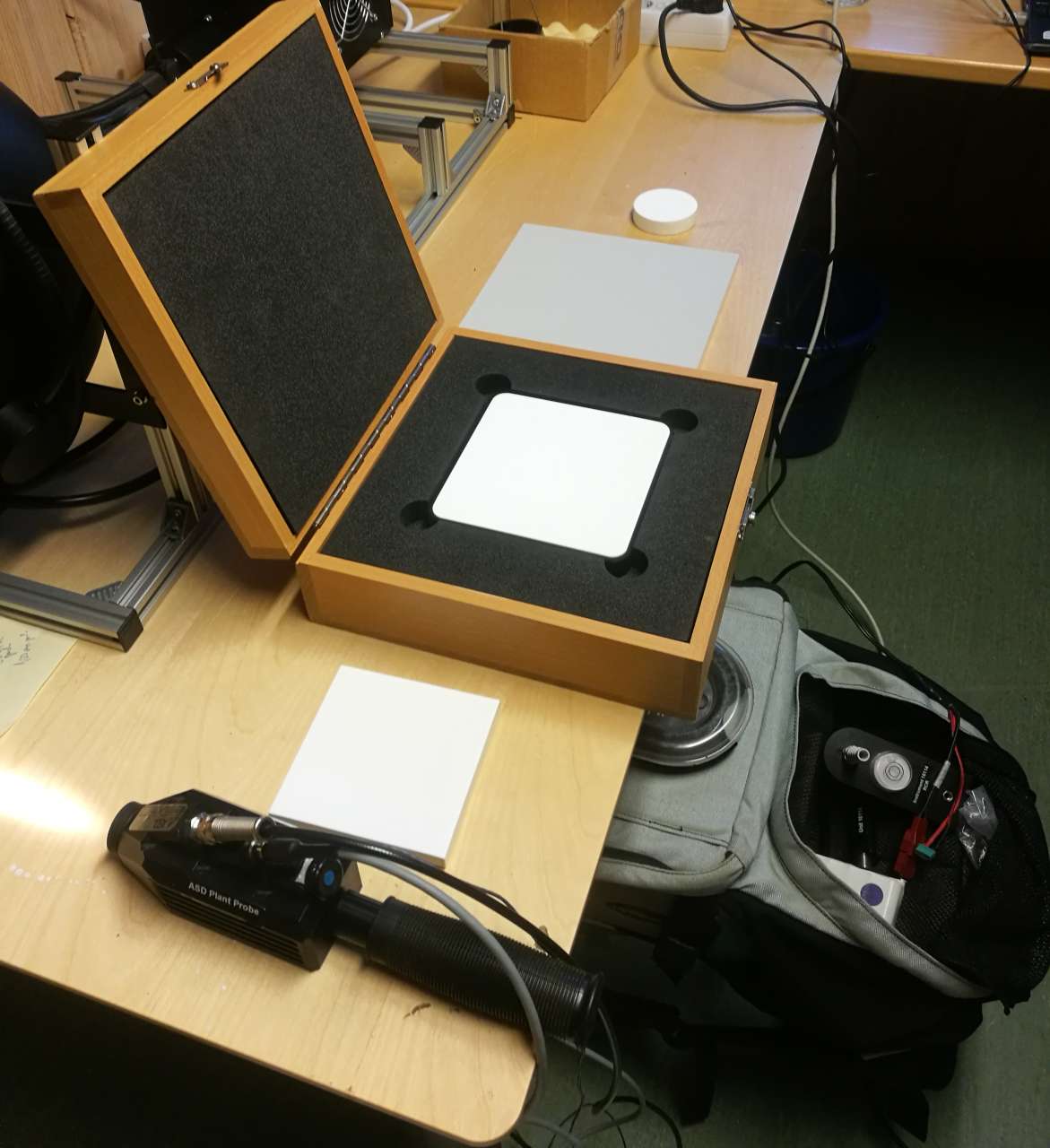
Foto: Jakob Geipel, NIBIO
Spektroskopi er en sentral teknologi i presisjonsjordbruk og innebærer å analysere hvordan lys samhandler med jord, planter og andre biologiske materialer for å hente ut informasjon om deres egenskaper. I motsetning til fjernmåling og nærmåling, som gir romlig informasjon i felt, brukes spektroskopi ofte i laboratoriet og i kontrollerte omgivelser for å oppnå svært detaljert innsikt i kjemisk sammensetning og struktur.
Ved Avdeling landbruksteknologi og Senter for presisjonsjordbruk benytter vi avanserte spektrometre og Raman-sensorer til å måle spektrale signaturer fra prøver i et bredt bølgelengdeområde. Disse målingene gjør det mulig å bestemme blant annet næringsinnhold, kvalitetsegenskaper og fysiologisk status på en rask og ikke-destruktiv måte. Spektroskopiske analyser gir dermed et viktig grunnlag for å utvikle og kalibrere modeller som kobler sensordata til agronomiske variabler.
For å sikre pålitelige resultater er det avgjørende med gode laboratoriemålinger som kan brukes som referanse (“bakkesannhet”) for data samlet inn i felt og fra luftbårne plattformer. Sammen med fjernmåling og nærmåling bidrar spektroskopi til å etablere en helhetlig forståelse av variasjon i jord og plantevekst, og danner grunnlaget for presise og stedstilpassede tiltak i landbruket.
KONTAKTPERSON

Krzysztof Kusnierek
Avdelingsleder/forskningssjef
-
Divisjon for matproduksjon og samfunn
(+47) 920 12 953 krzysztof.kusnierek@nibio.no Kontorsted: Apelsvoll

Jiangsan Zhao
Forsker
-
Divisjon for matproduksjon og samfunn
(+47) 413 23 321 jiangsan.zhao@nibio.no Kontorsted: Apelsvoll
KONTAKTPERSON
Krzysztof Kusnierek
Avdelingsleder/forskningssjef
-
Divisjon for matproduksjon og samfunn
(+47) 920 12 953 krzysztof.kusnierek@nibio.no Kontorsted: Apelsvoll
Jiangsan Zhao
Forsker
-
Divisjon for matproduksjon og samfunn
(+47) 413 23 321 jiangsan.zhao@nibio.no Kontorsted: Apelsvoll
Publikasjoner
Sammendrag
Interpreting multi-component 1H NMR spectra is difficult due to peak overlap, concentration variability, and low-abundance signals. We cast mixture identification as a single-pass multi-label task. A compact CNN–Transformer (“Hybrid”) model was trained end-to-end on domain-informed and realistically simulated spectra derived from a 13-component flavor library; the model requires no real mixtures for training. On 16 real formulations, the Hybrid attains micro-F1 = 0.990 and exact-match (subset) accuracy = 0.875, outperforming CNN-only and Transformer-only ablations, while remaining efficient (~0.47 M parameters; ~0.68 ms on GPU, V100). The approach supports abstention and shows robustness to simulated outsiders. Although the evaluation set was small, and the macro-ECE (per-class, 15 bins) was inflated by sparse classes (≈0.70), the micro-averaged Brier is low (0.0179), and temperature scaling had negligible effect (T ≈ 1.0), indicating the good overall probability quality. The pipeline is readily extensible to larger libraries and adjacent applications in food authenticity and targeted metabolomics. Classical chemometric baselines trained on simulation failed to transfer to real measurements (subset accuracy 0.00), while the Hybrid model maintained strong performance.
Sammendrag
Det er ikke registrert sammendrag
Sammendrag
Raman spectroscopy is a powerful and non-invasive analytical method for determining the chemical composition and molecular structure of a wide range of materials, including complex biological tissues. However, the captured signals typically suffer from interferences manifested as noise and baseline, which need to be removed for successful data analysis. Effective baseline correction is critical in quantitative analysis, as it may impact peak signature derivation. Current baseline correction methods can be labor-intensive and may require extensive parameter adjustment depending on the input spectrum characteristics. In contrast, deep learning-based baseline correction models trained across various materials, offer a promising and more versatile alternative. This study reports an approach to manually identify the ground-truth baselines for eight different biological materials through extensively tuning the parameters of three classical baseline correction methods, Modified Multi- Polynomial Fit (Modpoly), Improved Modified Multi-Polynomial Fitting (IModpoly), and Adaptive Iteratively Reweighted Penalized Least Squares (airPLS), and combining the outputs to best fit the training data. We designed a one-dimensional Transformer (1dTrans) tailored to fit Raman spectral data for estimating their baselines, and evaluated its performance against convolutional neural network (CNN), ResUNet, and three aforementioned parametric methods. The 1dTrans model achieved lower mean absolute error (MAE) and spectral angle mapper (SAM) scores when compared to the other methods in both development and evaluation of the manually labeled original raw Raman spectra, highlighting the effectiveness of the method in Raman spectra pre-processing.
Sammendrag
Det er ikke registrert sammendrag