New study documents TFA runoff from a Norwegian agricultural catchment
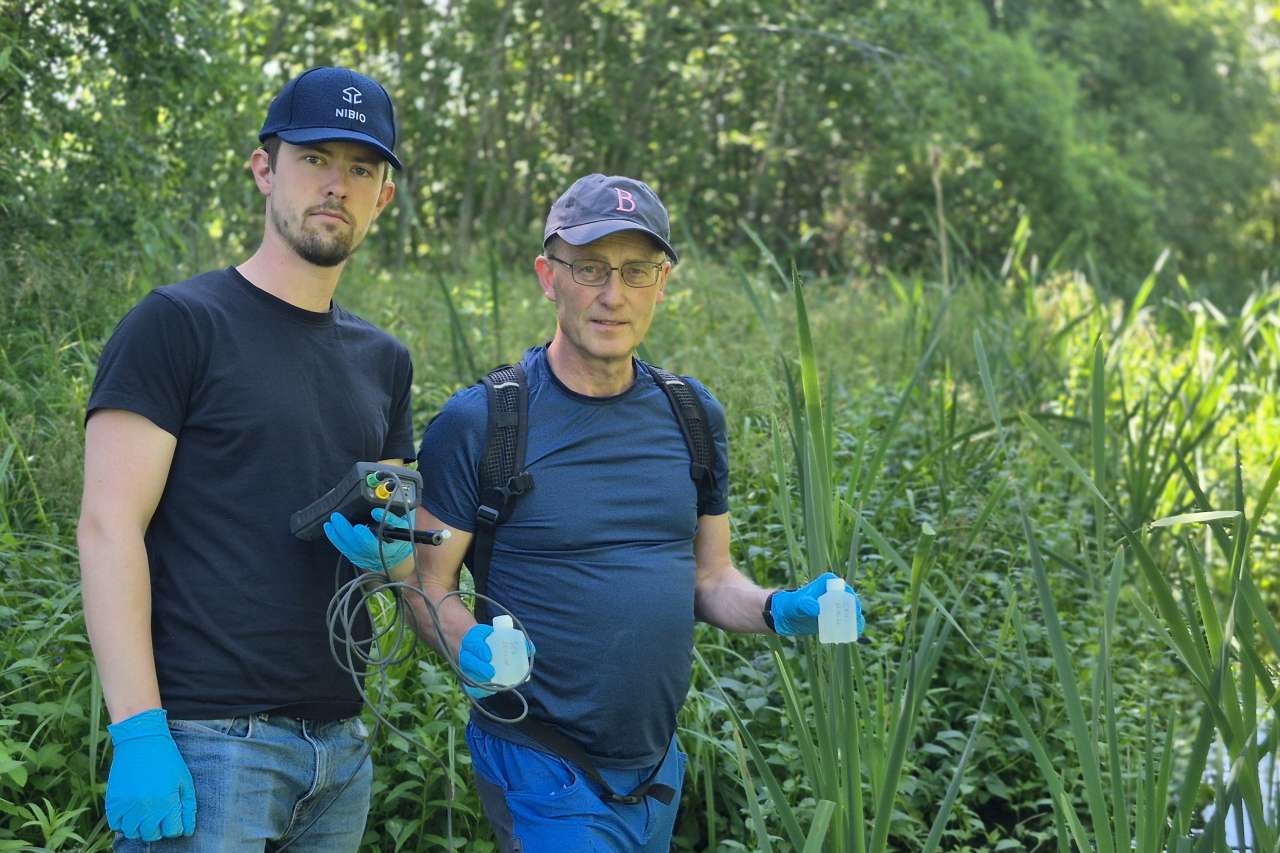
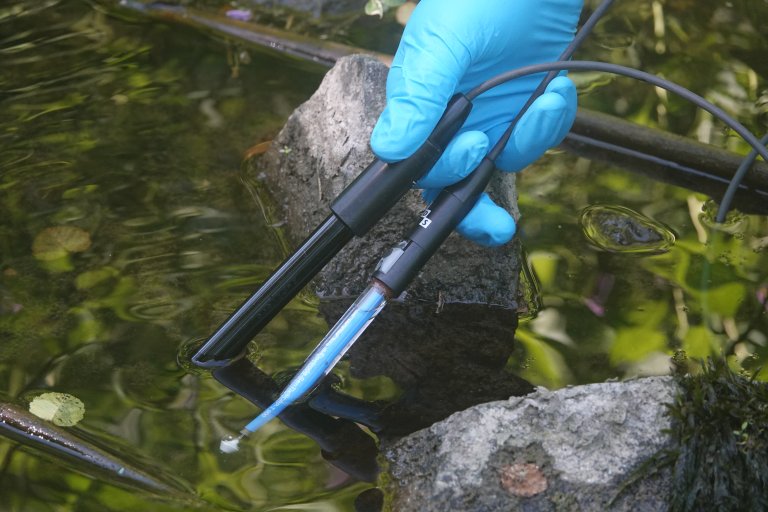
NIBIO has estimated how much TFA is washed out of a Norwegian agricultural catchment over the course of an entire year. Simen Gustu Johansen (left) and Roger Roseth collecting water samples in the Skuterud JOVA catchment in Ås. Photo: Morten Günther
TFA, a relatively little-known PFAS compound, is spreading in the environment. Researchers have now, for the first time, estimated how much is washed out of a Norwegian agricultural catchment over the course of an entire year.
Trifluoroacetic acid (TFA) is an ultra-short-chain PFAS compound that is highly soluble in water. In a new study, NIBIO researchers investigated how the substance behaves in the Skuterud catchment in Ås (Akershus county), one of Norway’s most intensively monitored agricultural catchments. By combining regular water sampling with continuous streamflow measurements, they were able to calculate the annual leaching of TFA.
Their calculations show that approximately 3.4 kilograms of TFA were transported out of the catchment via the Skuterud stream between March 2025 and March 2026.
“While the figure itself is uncertain and may be difficult to interpret, it provides an important first estimate of how much of this highly persistent PFAS compound is actually being washed out of a Norwegian agricultural catchment,” says Roger Roseth, who led the study.
Growing focus on “forever chemicals”
In recent years, TFA has been detected in an increasing number of environments worldwide, including precipitation, soils, rivers, groundwater and drinking water. Concentrations are also rising, and the compound is now considered the most widespread PFAS substance in the environment. PFAS are often referred to as “forever chemicals” because they break down extremely slowly in nature.
Interest in TFA has also increased across the Nordic countries. Studies from Sweden and Denmark, among others, have shown that TFA occurs in a large proportion of investigated water bodies, often at higher concentrations in areas with intensive human activity and agriculture.
In Norway, knowledge of the substance has so far been limited, but previous measurements have shown that TFA is present both in streams and in groundwater in agricultural areas.
Large seasonal variations in TFA leaching
The NIBIO study shows that transport in the Skuterud stream was unevenly distributed throughout the year.
“Most of the TFA runoff occurred during autumn 2025, when heavy rainfall and high streamflow resulted in increased transport from a reservoir of the substance that had built up during a relatively dry summer,” says Roseth.
“As much as 83 per cent of the annual leaching took place between September and December.”
In comparison, transport was considerably lower during the rest of the year. Only a small proportion was recorded during the summer months and early spring, when streamflow was lower.
Concentrations follow streamflow
TFA concentrations in the stream also varied throughout the year. The highest levels were measured during the first major autumn runoff event following a dry summer, while the lowest concentrations were recorded during periods of low streamflow in spring 2025 and 2026. Low concentrations were also observed during a snowmelt event characterised by surface runoff over frozen ground.
“The results suggest that TFA behaves in a similar way to nitrate in agricultural systems,” says Roseth.
“Both compounds are highly water-soluble and bind only weakly to soil. When heavy rainfall occurs, they are washed out of the soil and transported through drainage systems into streams and rivers.”
Several possible sources of TFA
The researchers assessed which sources may contribute to the presence of TFA in the area. The most likely sources are the breakdown of plant protection products containing certain PFAS-related compounds and deposition through precipitation that already contains TFA.
“In addition, there may be contributions from other sources, such as sewage sludge and livestock manure, but these remain poorly documented,” Roseth points out.
In the Skuterud catchment, calculations indicate that a large proportion of TFA inputs, around 70–80 per cent, may be linked to the use of pesticides that degrade into TFA. However, this assessment remains uncertain, partly because contributions from other sources have not yet been well characterised.
Other ultra-short-chain PFAS also detected
The study also shows that TFA is not the only ultra-short-chain PFAS compound present in the water. Low concentrations of two other compounds were detected, although at much lower levels than TFA.
Although TFA has so far been regarded as relatively low in toxicity, scientific understanding is evolving. The substance does not degrade in the environment and has already been detected in water, food, and biological samples from both humans and animals. Recent assessments suggest that it may be more problematic than previously assumed, and it is currently under evaluation within the EU regulatory system.
Roseth emphasises the need for more knowledge about how TFA is stored and transported in agricultural systems, and which sources contribute most significantly to environmental concentrations.
“More extensive sampling of soils, plants, drainage water and precipitation, as well as investigations into other potential sources such as sewage sludge, will be important for understanding how this highly persistent substance behaves in the environment over time.”
Contacts

Roger Roseth
Senior Research Scientist
-
Division of Environment and Natural Resources
(+47) 926 16 344 roger.roseth@nibio.no Office Location: Ås O43
Contacts
Roger Roseth
Senior Research Scientist
-
Division of Environment and Natural Resources
(+47) 926 16 344 roger.roseth@nibio.no Office Location: Ås O43
Publications
Abstract
Trifluoreddiksyre (TFA) er en persistent ultrakort PFAS-forbindelse som blir gjenfunnet i økende konsentrasjoner i drikkevann og mat både internasjonalt og i Norge. Det er mange kilder som kan bidra med tilførsler av TFA, men atmosfærisk nedbrytning av fluorerte kjølegasser samt nedbrytning av PFAS-baserte (CCF3) plantevernmidler brukt i jordbruk, vurderes som de viktigste. Denne rapporten presenterer TFAkonsentrasjoner målt i Skuterudbekken i 2025 og begynnelsen av 2026. Årlig tap av TFA fra JOVA-feltet Skuterud (4489 daa) ble beregnet til 3,3 kg. Det største tapet skjedde under større flommer høsten 2025, og korrelerte godt med utvasking av nitrat. Tilsvarende som for nitrat antas den største utvaskingen av TFA fra dyrka jord å skje via grøftevann. Data fra store nedbørfelt dominert av skog i Østlandsområdet kan indikere at TFA tilført med nedbør gir en «bakgrunnskonsentrasjon» på ca. 200 ng/l. I Skuterudbekken var midlere TFAverdi for 23 prøver på 1083 ng/l. Tallene kan indikere at bruk av CCF3-plantevernmidler kan forklare mer enn 80 % av årlig utvasking av TFA fra Skuterudfeltet, mens nedbørtilført TFA utgjør mindre enn 20 %. Kloakkslam kan være en ikke kvantifiserbar kilde til TFA i nedbørfeltet. Feltet er dominert av korndyrking på marin jord, og har 61 % jordbruksareal, 29 % skog og 10 % annet areal. Utvaskingen av TFA fra nedbørfeltet viste godt samsvar med TFA-ekvivalenter i anvendte CCF3-plantevernmidler, som har vist en årsvariasjon mellom 1,6 og 5,6 kg TFA per år, og et snitt på 3,8 kg. En del av tilført TFA vil fjernes med avling i form av korn og presset halm, eller annen avling. I tillegg til TFA ble det av og til påvist to andre ultrakorte PFAS-forbindelser; perfluorpropionsyre og trifluor metansulfonsyre, som antas å være metabolitter i samme nedbrytningsforløp.

_Andrea_spr%C3%B8yte_eplekvalitet_cropped.png?quality=60)