
Erling Meisingset
Forsker
(+47) 918 08 860
erling.meisingset@nibio.no
Sted
Tingvoll
Besøksadresse
Gunnars veg 6, 6630 Tingvoll
Forfattere
Atle Mysterud William Ryan Easterday Vetle Malmer Stigum Anders Aas Erling Meisingset Hildegunn ViljugreinSammendrag
Global environmental changes are causing Lyme disease to emerge in Europe. The life cycle of Ixodes ricinus, the tick vector of Lyme disease, involves an ontogenetic niche shift, from the larval and nymphal stages utilizing a wide range of hosts, picking up the pathogens causing Lyme disease from small vertebrates, to the adult stage depending on larger (non-transmission) hosts, typically deer. Because of this complexity the role of different host species for emergence of Lyme disease remains controversial. Here, by analysing long-term data on incidence in humans over a broad geographical scale in Norway, we show that both high spatial and temporal deer population density increase Lyme disease incidence. However, the trajectories of deer population sizes play an overall limited role for the recent emergence of the disease. Our study suggests that managing deer populations will have some effect on disease incidence, but that Lyme disease may nevertheless increase as multiple drivers are involved.
Forfattere
Manuela Panzacchi Bram Van Moorter Erik Stange Trond Simensen Markus A. K. Sydenham Neri Horntvedt Thorsen Bernardo Brandão Niebuhr Christer Moe Rolandsen Erling Johan Solberg Atle Mysterud Erling Meisingset Barbara Zimmermann Inger Maren RivrudSammendrag
Grønn infrastruktur i norsk natur . Webinar åpent til alle arrangert av Miljødirektoratet
Forfattere
Julian Oeser Rafał Kowalczyk Dries Kuijper Wiebke Neumann Rudolf Reiner Rupert Seidl Cornelius Senf Hendrik Bluhm Nadège C. Bonnot Luca Börger Tomasz Borowik Francesca Cagnacci Marcin Churski Benedikt Gehr Marco Dietmar Heurich A. J. Mark Hewison Klemen Jerina Max Kröschel Nicolas Morellet Atle Mysterud Nives Pagon Gabriele Retez Sebastian Seibold Rita T. Torres Alba Viana-Soto Adrian Mihai Aldea Roksana Baryło Sophie Baur Sebastian Catanoiu Rok Černe Marcin Grzegorzek Dário Hipólito Maciej Januszczak Anders Jarnemo Miloš Ježek Artūras Kibiša Daniel Klich Alain Licoppe Julien Lievens Matthias-Claudio Loretto Weronika Maślanko Erling Meisingset Rasmus Mohr Mortensen András Náhlik Wanda Olech Astrid Olejarz Federico Ossi Algimantas Paulauskas Maryline Pellerin Kajetan Perzanowski Wibke Peters Mirosław Ratkiewicz Thomas Rempfler Sonia Saïd Călin Constantin Șerban Kastytis Šimkevičius Jakub Skorupski Maria Sobczuk Nikica Šprem Peter Sunde Tamás Tari Maciej Tracz Magdalena Tracz Aleksandra Wołoszyn-Gałęza Tobias KuemmerleSammendrag
Forest disturbances have increased in many regions, but how they impact habitat suitability for wildlife remains poorly understood. Here, by combining tracking data on 3,069 individuals of four ungulate species (European bison, moose, red deer and roe deer) with satellite-based maps, we perform a continental, multi-decadal assessment of large herbivore responses to forest disturbance. Despite strong intraspecific variation, all species show an increased selection of disturbed areas for ≥35 years after disturbance. Although the patterns closely reflect species-specific foraging strategies, all species selected more strongly for smaller disturbance patches, depending on the availability of alternative foraging habitats (grasslands and croplands). Model projections across the species’ range extents show positive but regionally varying effects of forest disturbances on habitat suitability between 2000 and 2023. Our findings indicate that forest disturbances can attract large herbivores and that the recent increase in forest disturbances improved habitat suitability for our study species across Europe, highlighting the importance of considering long-term disturbance-related dynamics for wildlife and forest management. Given expected future increases in disturbance, resulting habitat improvements could amplify conflicts with forestry, but also contribute to restoring large herbivores and their ecological functions.
Forfattere
Björn H. Franke Aafke M. Schipper Tal Avgar Luca Börger Nilanjan Chatterjee Thomas Müller Brian J. Smith Briana Abrahms Abdullahi H. Ali Nina Attias Hattie L. A. Bartlam‐Brooks Floris M. van Beest Jerrold L. Belant Dean E. Beyer Niels Blaum Michael B. Brown Bayarbaatar Buuveibaatar Francesca Cagnacci Simon Chamaillé‐Jammes Nandintsetseg Dejid Jasja Dekker Arnaud L. J. Desbiez Julian Fennessy Christina Fischer Ilya Fischhoff Adam T. Ford Benedikt Gehr Jacob R. Goheen Ronaldo Gonçalves Morato Mark Hebblewhite Robert Hering Marco Heurich A. J. Mark Hewison Lynne A. Isbell Matthew Kauffman Andrew Jakes René Janssen Paul F. Jones Bob Jonge Poerink Clayton Lamb John Durrus Linnell A. Catherine Markham Courtney J. Marneweck Jenny Mattisson John McEvoy Erling Meisingset Evelyn Merrill Guilherme de Miranda Mourão Bram Van Moorter Nicolas Morellet Atle Mysterud John Odden Kirk A. Olson Agustín Paviolo Tyler Petroelje Kelly M. Proffitt Kasim Rafiq Nathan Ranc Christer Moe Rolandsen Daniel I. Rubenstein Sonia Saïd Hall Sawyer Niels Martin Schmidt Nuria Selva Agnieszka Sergiel Erling Johan Solberg Melissa Songer Jonas Stiegler Olav Strand Siva Sundaresan Jeffrey J. Thompson Wiebke Ullmann Dorj Usukhjargal Ulrich Voigt Filip Zięba Tomasz Zwijacz‐Kozica Mark A. J. Huijbregts Marlee A. TuckerSammendrag
Aim Animal movements are a fundamental process affecting communities and ecosystems. Quantifying habitat selection across species and habitats is key for understanding how animals respond to environmental change. Currently, we lack comparative studies that examine how habitat selection varies across species traits and landscapes. We aim to quantify global patterns of habitat selection to help understand the fundamental drivers of movement behaviour. Location: Global. Time Period: Contemporary. Major Taxa Studied: Terrestrial mammals. Methods We estimated selection coefficients for terrain ruggedness, vegetation productivity, human population density and distance to roads of individual terrestrial mammals through step‐selection analysis of 1344 GPS tracks across 48 species. We quantified intra‐ and interspecific variation and tested whether selection coefficients were associated with species traits and habitat availability. Results We observe an overall avoidance of roads and areas of high human population density as well as rugged terrain, with a large proportion of individuals selecting for areas of intermediate NDVI. However, we also found large intraspecific variation in habitat selection and show that this variation is predicted by local and landscape‐level environmental conditions rather than species traits. Individuals in more remote areas exhibited weaker functional responses to human presence than those in more disturbed areas. Avoidance of rugged terrain is also context‐dependent, with stronger avoidance when local ruggedness is high. The only exception to the observed intraspecific variability is consistent species‐level responses to road proximity. Main Conclusions Our findings contribute to the understanding of habitat selection by terrestrial mammals, showing that selection is largely shaped by environmental conditions and that animals exhibit high plasticity in their responses. Our results also provide further evidence for the significant impact of roads on animal movement. These insights can help us to understand the potential effects of environmental change on the behaviour of mammal species around the world.

Overlappende smittestoffer hos hjort og småfe
Divisjon for skog og utmark
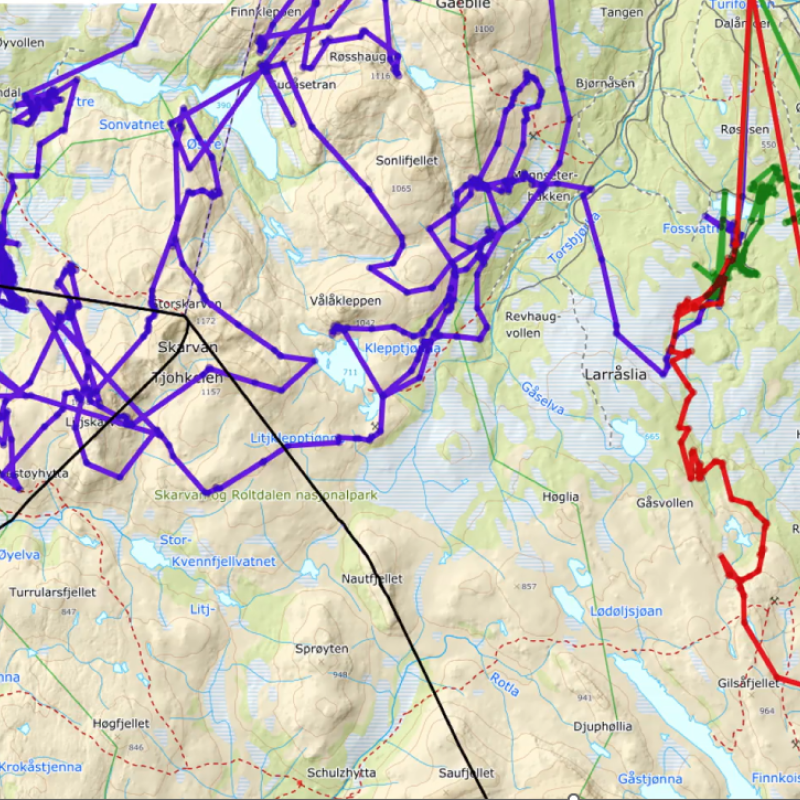
Red deer and damages: Red deer space use, population ecology and level of grazing damages to farmland and forests
I Norge har det vært en stor økning i hjortebestanden (Cervus elaphus L.), spesielt i kjerneområdene på Vestlandet. Som et resultat av dette har skader på skog og innmark i landbruket økt. Det er imidlertid begrenset kunnskap om beiteskadene i tid og rom, og hvilke faktorer som påvirker skadesituasjonen.
Divisjon for skog og utmark
SPOR
Prosjektet