
Faustine Kasongi Enos
Stipendiat
(+47) 403 19 443
faustine.enos@nibio.no
Sted
Særheim
Besøksadresse
Postvegen 213, NO-4353 Klepp stasjon
Sammendrag
Greenhouse cultivation can help meet food demand in a growing and increasingly urbanised population. Reliance on fossil-fuel heating and natural ventilation often makes conventional greenhouses energy- and carbon-inefficient. Closed greenhouses address these limitations through resource recycling and energy recovery. While a centralised environmental control system (ECS) integrating climate control and heat harvesting has shown potential to improve greenhouse crop performance at high latitudes, its year-round energy use and energy-related carbon footprint reduction potential remains insufficiently quantified. This study extends an existing dynamic greenhouse climate model to incorporate a novel centralised ECS integrating air recirculation, heating, cooling, and heat harvesting in (semi-)closed greenhouses. The model was validated using experimental data from Norway, reproducing temperature and relative humidity with RMSEs of 1.40–1.63 °C and 7.60–8.55%, respectively. Energy use and tomato yield were predicted with relative errors of 3.8–8.4% and 1.6–4.2%, respectively. Scenario simulations under Norwegian conditions showed that (semi-)closed greenhouses with heat harvesting can reduce fossil fuel use by over 80% while increasing tomato yields by 15–41% relative to open greenhouses, driven by changes in CO2 concentration and temperature following reduced ventilation and heat recovery. The performance of a fully closed greenhouse relying solely on on-site cold storage is constrained by cooling capacity and buffer size, particularly during summer; adding a supplemental cold energy source such as surface water can improve its performance. Despite heat harvesting, a residual boiler heating demand of 3–10% remains. Further gains in energy efficiency and crop performance may be achieved through optimised climate control.
Sammendrag
Greenhouse tomato production at high latitudes requires substantial inputs of supplemental lighting, heating and climate control. (Semi-) closed greenhouses can improve heat, water and CO₂ retention, but require additional electricity, climate control system capacities and investment. Crop productivity and resource use must therefore be evaluated jointly. This paper presents the EFREE-Green systems framework for integrating local production conditions, greenhouse environmental control, crop physiological responses, resource flows, and economic and environmental performance. The framework is implemented in two experimental greenhouse compartments operating at a semi-commercial scale at NIBIO Særheim, Norway, connected to a centralized environmental control system (ECS). Measurements at leaf, canopy and greenhouse scale link environmental control with crop carbon gain, biomass partitioning, marketable yield and resource use. Illustrative observations demonstrate that crop responses to supplemental lighting depend on interactions among light availability, CO₂ supply and climate management. Experimental measurements, modelling, techno-economic assessment and life-cycle assessment are combined to evaluate crop productivity, energy efficiency, resource recovery, production costs and greenhouse gas emissions. The framework is transferable to other climatic and production settings, but optimal technologies, capacities and control strategies remain location-specific.
Sammendrag
Energy-efficient greenhouse climate control is important in high-latitude regions, where heating demand is high and minimizing environmental impacts is increasingly necessary. In this study, a novel centralized environmental control system (ECS) was implemented in a semi-closed tomato greenhouse under Norwegian conditions. The ECS integrates heating, cooling, dehumidification, and heat recovery through air-to water heat exchangers, a heat pump, and thermal energy storage system to support climate control and energy management. The ECS was monitored across three tomato production experiments conducted during summer and winter seasons, and its operational performance was evaluated based on greenhouse climate, tomato yield, and energy use. The experiments included variations in temperature setpoints and cooling capacity. The ECS maintained greenhouse climate that was suitable for tomato production across all experiments. Changes in temperature setpoints and cooling capacity affected ECS electricity consumption and influenced the balance between recovered heat and boiler heating, while having limited effects on tomato yield. The results indicate the potential of centralized ECS technology to sustain tomato production while reducing reliance on fossil-energy, supporting the transition towards energy-efficient and emission-free smart greenhouse production.

Divisjon for matproduksjon og samfunn
Planteproduksjon i kontrollert klima
Divisjon for bioteknologi og plantehelse
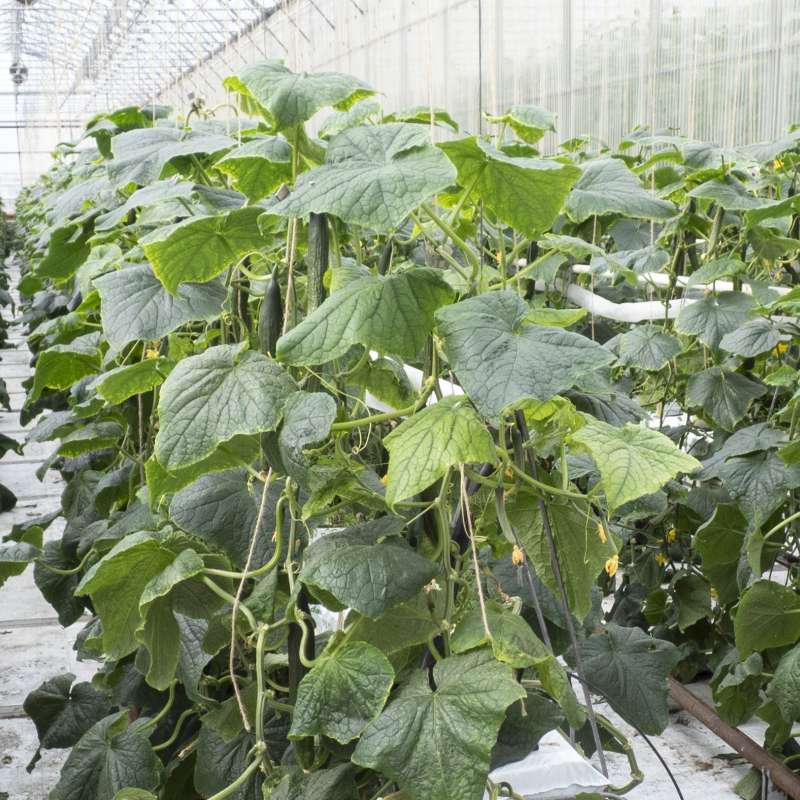
FriskAgurk: Bærekraftig plantehelse i moderne veksthusagurkproduksjon
FriskAgurk-prosjektet har som hovedmål å finne løsninger for plantehelserelaterte utfordringer som oppstår i forbindelse med moderne veksthusproduksjon av agurk i Norge.
Divisjon for bioteknologi og plantehelse
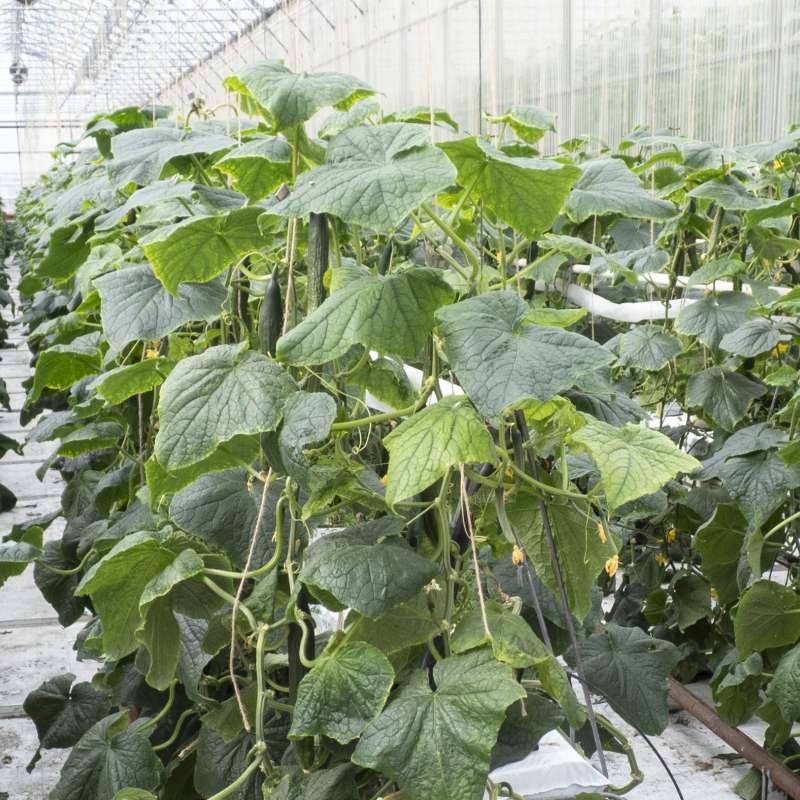
HealthyCucumber: Sustainable plant health management in modern greenhouse cucumber production
The HealthyCucumber project aims to find plant health solutions for challenges related to modern greenhouse production of cucumber in Norway.