
Krzysztof Kusnierek
Head of Department/Head of Research
(+47) 920 12 953
krzysztof.kusnierek@nibio.no
Place
Apelsvoll
Visiting address
Nylinna 226, 2849 Kapp
Abstract
Neural Radiance Fields (NeRF) have been widely adopted for reconstructing high-quality 3D scenes from 2D RGB images. However, achieving accurate 3D object segmentation within these reconstructed scenes remains challenging. Existing NeRF-based segmentation methods either rely on post-processing (SA3D), which produces noisy point clouds due to the absence of density field optimization, or employ joint training with additional segmentation heads (FruitNeRF), which can lead to suboptimal performance due to conflicting learning objectives. In this work, we propose InvNeRF-Seg (Input-substitution NeRF for Segmentation), a two-stage fine-tuning strategy for 3D object segmentation that preserves the original NeRF architecture and loss function entirely. We first train a standard NeRF on RGB images and then fine-tune it using 2D segmentation masks formatted as RGB-like inputs, without introducing any architectural modifications or additional loss functions. This input-substitution approach reshapes the density field to align with object regions while suppressing background density. We validate InvNeRF-Seg through comprehensive ablation studies examining the roles of density and color MLPs, loss function choices, and training strategies. Field density analysis reveals consistent semantic refinement: densities of object regions increase while background densities are suppressed. Experiments on synthetic fruit datasets and real-world soybean imagery demonstrate that InvNeRF-Seg produces cleaner 3D segmented point clouds compared to both SA3D and FruitNeRF, enabling more accurate downstream object counting. The method is further validated on a self-collected soybean dataset to demonstrate its applicability in real-world agricultural scenarios.
Authors
Bart Vandecasteele Simon Craeye Kristof Gheysens Peter Melis Hanne Denaeghel Krzysztof Kusnierek Rianne Visser Dries VandammeAbstract
No abstract has been registered
Abstract
Fruit quality is a major determinant of commercial success in raspberry cultivars. Yet the established ways of measuring quality: chromatography and trained sensory panels, are slow, costly and, for sensory work, variable. Raman spectroscopy is a rapid, reagent-free alternative based directly on molecular vibrations, and is now available in handheld form. Nine raspberry cultivars and two breeding selections were grown in an open polytunnel at NIBIO Apelsvoll, Norway, in 2023, and berries were sampled early and a late in the harvest season. Spectra were recorded with an 830 nm handheld instrument from intact berries and from pressed, centrifuged juice and related to HPLC analyses and sensory panel taste scores. Empirical multivariate models based on partial least squares regression, applied to pre-processed spectra of raspberry juice samples, showed promising potential for estimating total sugars (R2cv = 0.96, RMSECV = 3.4 g L-1), the sugar/acid ratio (R2cv = 0.96) and citric acid (R2cv = 0.94), and moderate potential for the sensory taste score (R2cv = 0.55 on a 1-9 scale). Regression coefficients and VIP scores placed the models on sugar bands near 1065, 1085 and 1128 cm-1 and on citrate bands near 940 and 1720 cm-1, matching published assignments. A calibration-free two-band ratio, I(1115-1145)/I(925-960), tracked the sugar/acid ratio almost as well as the full model (r = 0.945). Measurements of intact berries could not be used for estimating any property (R2cv <= 0.36); the relative standard error of the sugar band was 7.0-9.3% per scan against 1.9% for juice, identifying drupelet heterogeneity rather than absent signal as the obstacle. Handheld Raman spectroscopy shows promising potential as a rapid screening tool for extracted raspberry juice, however for measurement of the intact fruit further method development is needed.
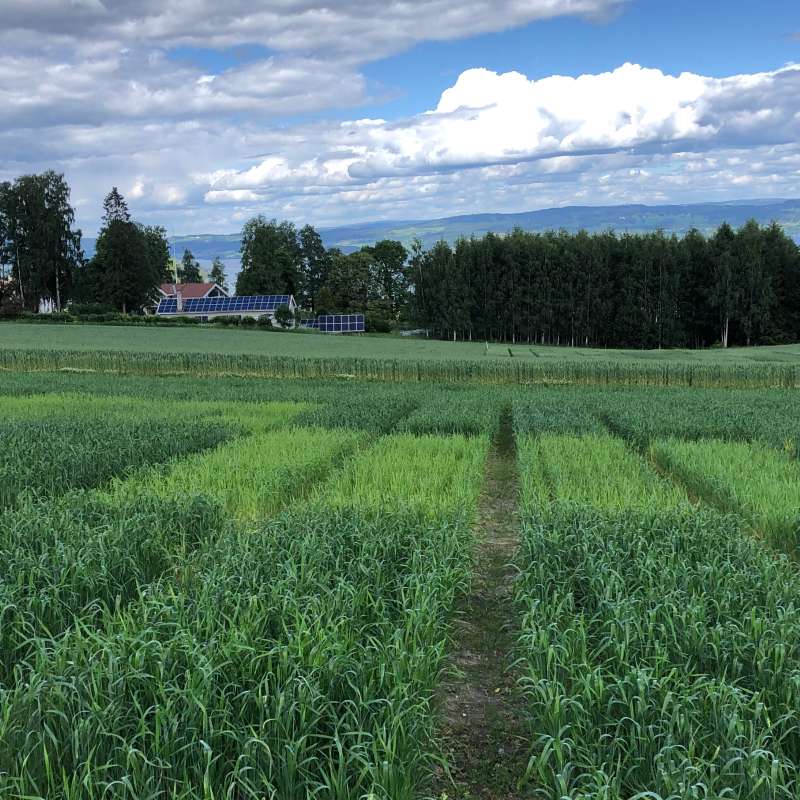
Division of Food Production and Society
Gene2Bread: Building knowledge and exploiting technology to achieve high wheat self-sufficiency in Norway
The project aims to increase Norway’s self-sufficiency in milling wheat by gaining knowledge to improve wheat quality and increase its utilisation. Adequate protein content and a stable quality between seasons and within a season are prerequisites to increasing the share of Norwegian wheat in the flour blend.
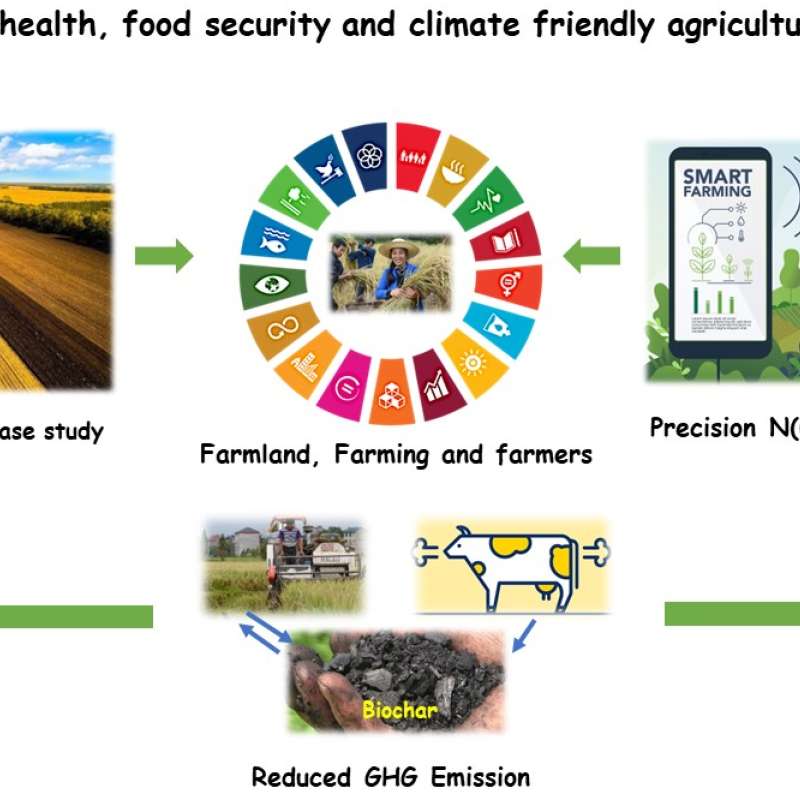
Division of Environment and Natural Resources
Sinograin III: Smart agricultural technology and waste-made biochar for food security, reduction of greenhouse gas (GHG) emission, and bio-and circular economy
The Sinograin III project’s overall objective is to contribute to the UN SDGs by widely implementing precision agriculture technologies and application of “waste-to-value” biochar products to achieve sustainable food production with minimized GHG emission, improve soil fertility and promote green growth/zero waste in modern agriculture in China.