
Jakob Geipel
Research Scientist
Biography
Jakob is a research scientist working at the intersection of precision agriculture, remote sensing and digital agricultural technology. With a PhD in Agricultural Sciences and a background in geoinformatics and surveying engineering, he develops sensor- and data-driven approaches for more precise, efficient and knowledge-based crop production.
His research integrates satellite, drone and ground-based observations with multispectral and hyperspectral analysis, radiometric calibration, agricultural modelling, machine learning and artificial intelligence. The work focuses on extracting reliable and actionable information about biomass, yield, crop quality and nutrient status, particularly in cereals, grassland and potato production.
He leads the development of digital web services and scalable data-processing pipelines that translate research methods and geospatial data into practical tools for precision fertilization, crop monitoring and decision support. An important direction of his work is the integration of new sensor technologies, AI-based analytics and agricultural knowledge into robust digital services adapted to changing user needs and Norwegian agricultural conditions.
Keywords
Precision agriculture; remote sensing; geoinformatics; multispectral and hyperspectral sensing; radiometric calibration; satellite and drone data; sensor systems; machine learning; artificial intelligence; agricultural modelling; crop monitoring; data pipelines; digital web services; decision support.
Background
2012-2016: Dr. sc. agr. (Ph.D.) in Agricultural Sciences at the Institute of Crop Science, Department of Agronomy, University of Hohenheim, Germany
2009-2012: M.Sc. in Geoinformatics at the Institute for Geoinformatics, University of Münster, Germany
2005-2009: Dipl.-Ing. (FH) in Surveying Engineering and Geoinformatics at the University of Applied Sciences Würzburg-Schweinfurt, Germany
Abstract
Neural Radiance Fields (NeRF) have been widely adopted for reconstructing high-quality 3D scenes from 2D RGB images. However, achieving accurate 3D object segmentation within these reconstructed scenes remains challenging. Existing NeRF-based segmentation methods either rely on post-processing (SA3D), which produces noisy point clouds due to the absence of density field optimization, or employ joint training with additional segmentation heads (FruitNeRF), which can lead to suboptimal performance due to conflicting learning objectives. In this work, we propose InvNeRF-Seg (Input-substitution NeRF for Segmentation), a two-stage fine-tuning strategy for 3D object segmentation that preserves the original NeRF architecture and loss function entirely. We first train a standard NeRF on RGB images and then fine-tune it using 2D segmentation masks formatted as RGB-like inputs, without introducing any architectural modifications or additional loss functions. This input-substitution approach reshapes the density field to align with object regions while suppressing background density. We validate InvNeRF-Seg through comprehensive ablation studies examining the roles of density and color MLPs, loss function choices, and training strategies. Field density analysis reveals consistent semantic refinement: densities of object regions increase while background densities are suppressed. Experiments on synthetic fruit datasets and real-world soybean imagery demonstrate that InvNeRF-Seg produces cleaner 3D segmented point clouds compared to both SA3D and FruitNeRF, enabling more accurate downstream object counting. The method is further validated on a self-collected soybean dataset to demonstrate its applicability in real-world agricultural scenarios.
Authors
Jakob GeipelAbstract
This report evaluates the practical guidance accuracy of a John Deere 6130R tractor equipped with a John Deere AutoTrac autosteering system and a StarFire 6000 GNSS receiver. The experiment was conducted at NIBIO Apelsvoll, Norway, using a Trimble S3 robotic total station as an independent reference measurement system. Tractor trajectories were measured while driving along predefined guidance lines at travel speeds of 7, 10 and 13 km h-1. A total of 1097 position measurements were analysed. Mean cross-track deviations ranged from 4.2 to 5.2 cm, while standard deviations ranged from 3.3 to 4.0 cm. 95% of all observations remained within approximately 10 to 13 cm of the intended trajectory. Pass-to-pass deviations ranged from 0.7 to 2.9 cm, indicating good consistency between neighbouring guidance passes. The results indicate stable centimetre-level guidance performance throughout the tested operating range. Differences between travel speeds were small and are unlikely to be operationally important for most agricultural field operations. The measured guidance performance is compatible with the requirements of modern precision-agriculture applications such as tillage, sowing, fertiliser spreading and crop protection.
Abstract
IMPRESS-prosjektet undersøkte respons på stigende mengder mineralgjødsel-N i eng på to lokaliteter. Tørrstoffavlingen økte tydelig fra lave til moderate N-nivåer, men meravlingen ble liten mot toppen av gjødslingsstigen. Samtidig økte mengden høstet N og differansen mellom tilført mineralgjødsel-N og høstet N. Nitrogendifferansen er en partiell beregning og skal ikke tolkes som målt N-tap. Kløverinnholdet avtok med stigende N-tilførsel. Endringene i fôrkvalitet var ikke like entydige. Innholdet av råprotein og NDF kunne øke, mens FEm-innholdet og fordøyelighet kunne avta. Resultatene samsvarer med andre nyere norske forsøksresultater. De gir ikke grunnlag for å betrakte de høyeste tilførselsmengdene av N som optimale eller for å anbefale en generell økning i gjødslingsnormene. N-gjødslingen bør tilpasses forventet avling, kløverandel, antall slåtter, engalder og lokale vekstforhold.
Division of Biotechnology and Plant Health
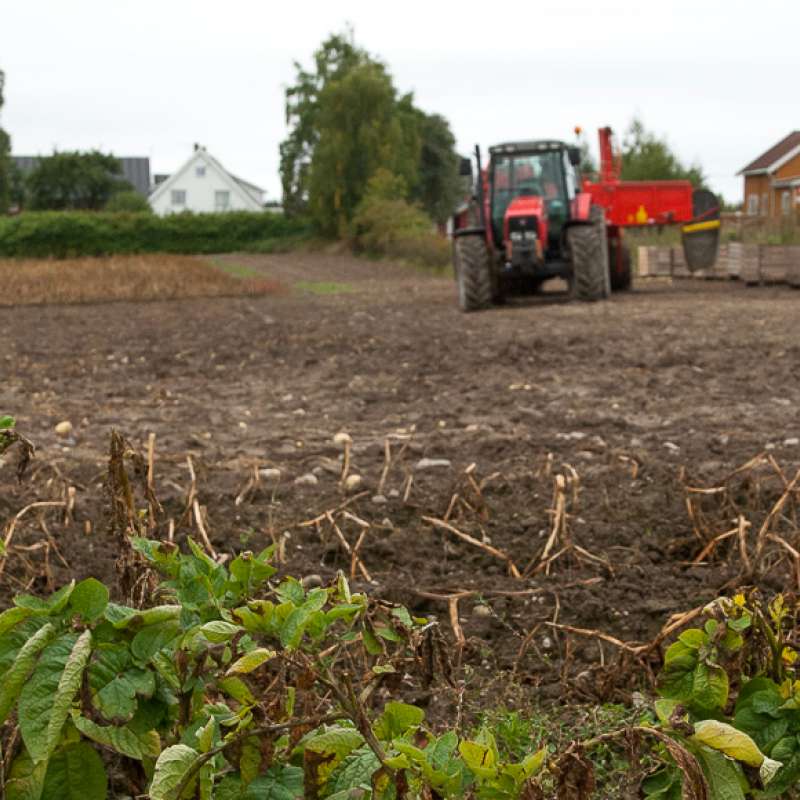
SOLUTIONS: New solutions for potato canopy desiccation, control of weeds and runners in field strawberries & weed control in apple orchards
Efficient measures for weed control and similar challenges are vital to avoid crop loss in agriculture. National supply of food, feed and other agricultural products depends on each farmer’s success managing their fields and orchards. The recent loss of the herbicide diquat, and the potential ban on glyphosate, - both important tools for farmers -, raise a demand for new measures for vegetation control. Efficient alternatives to herbicides are also important tools in Integrated Pest Management (IPM). Norwegian growers need to document compliance to IPM since 2015 to ensure minimum hazards to health and environment from pesticide use.
Division of Food Production and Society
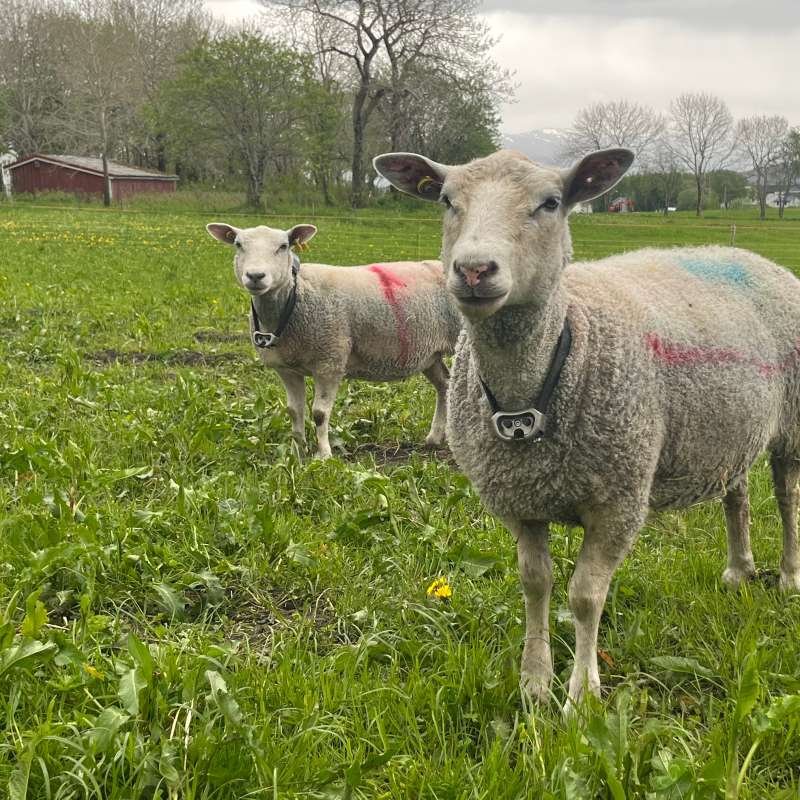
Techgraze – Integrating Advanced Technologies for Enhanced Grazing Practices in Norway
In Norway, a declining grazing pressure and farm abandonment have led to undesirable ecological and socio-economic outcomes. The TechGraze project aims to address these challenges by integrating Virtual Fencing (VF) and Remote Sensing (RS) technologies to enhance pasture-based livestock management.