Long fibres and high density—sawn timber from Northern Norway shows good quality
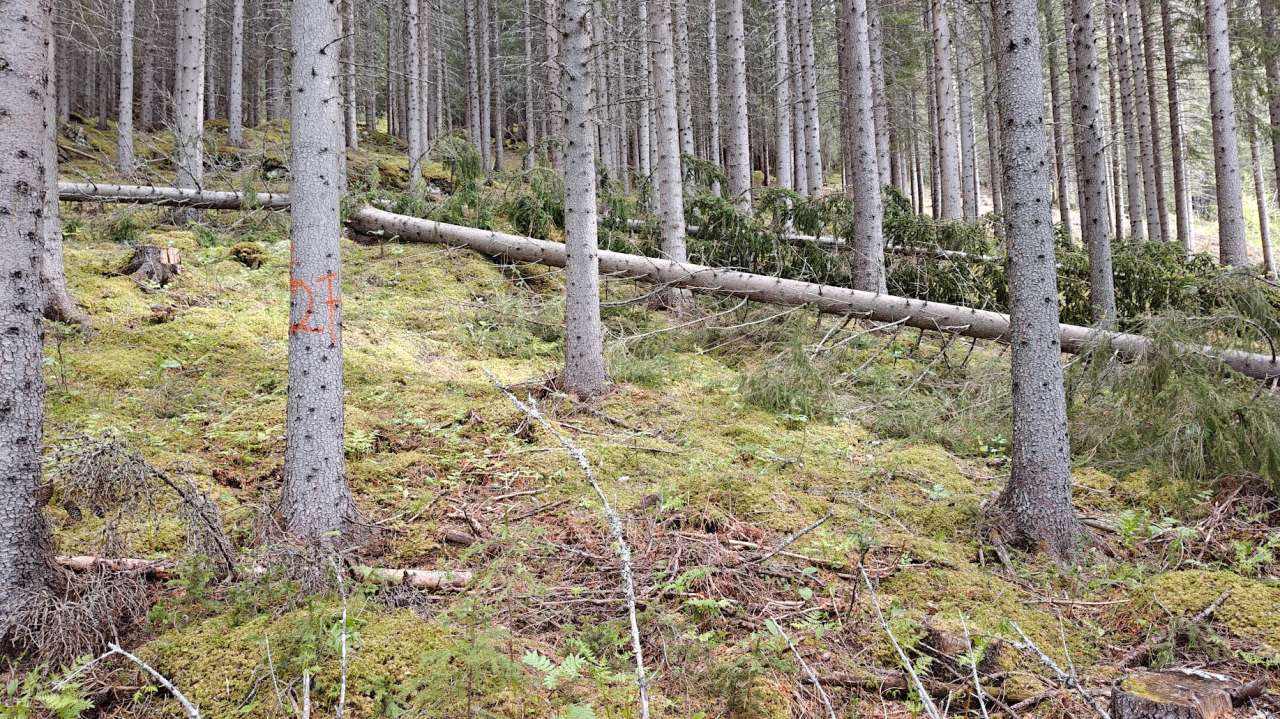
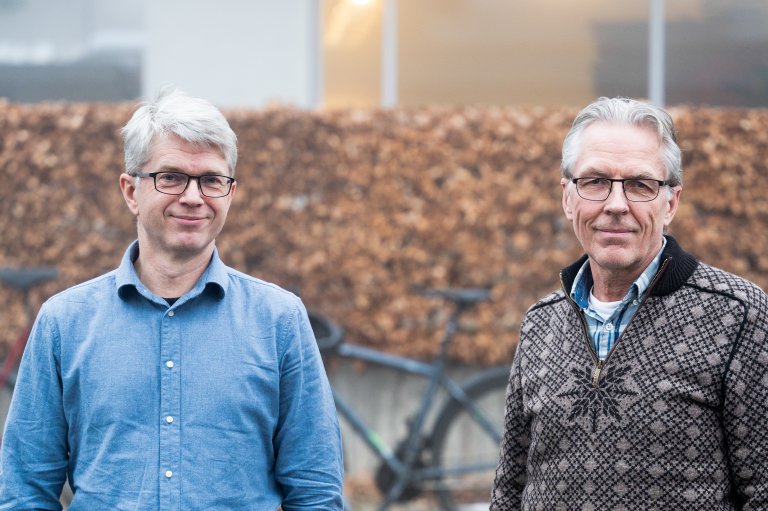
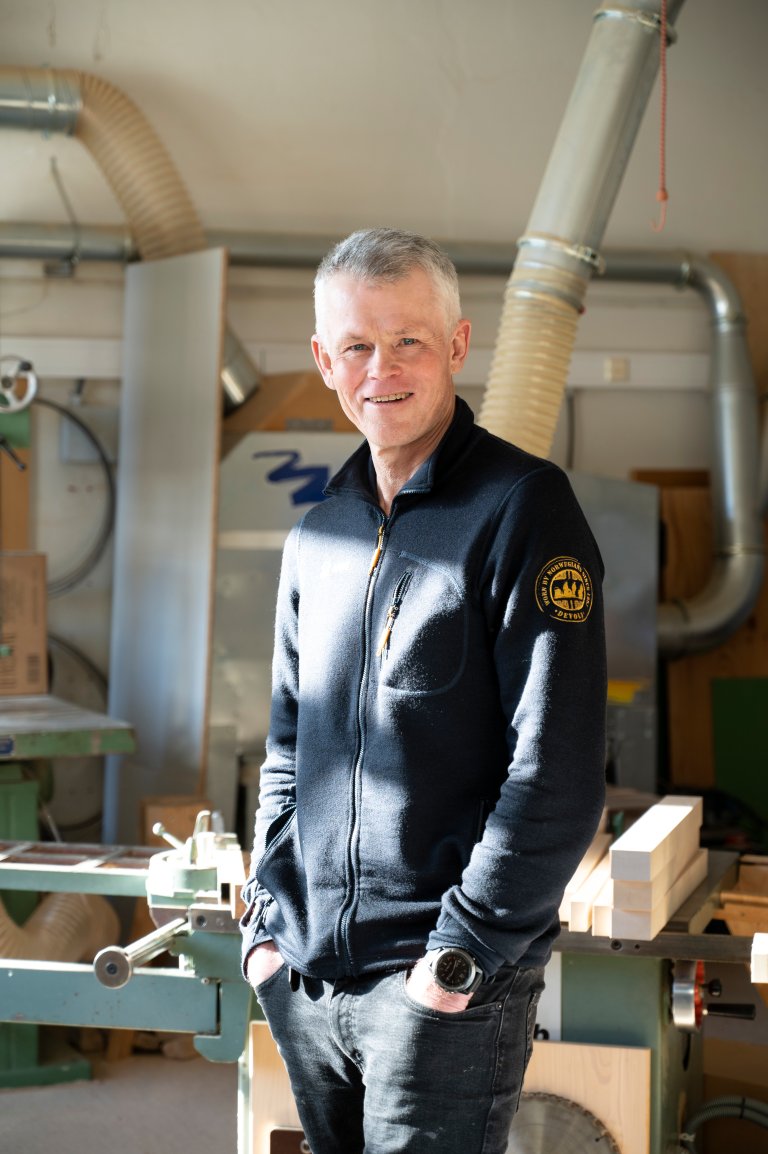
Studies of Northern Norwegian spruce show that it is somewhat lighter than spruce from Southern Norway. However, it still demonstrates good strength, stiffness, and flexibility. Photo: Eirik Nordhagen, NIBIO
In the 1940s and 50s, spruce trees were planted in large areas in Northern Norway. These forests are now reaching maturity for harvesting. However, a long-standing question has been whether northern Norwegian spruce sawn timber has sufficient strength properties for use in load-bearing structures. According to new studies, the answer is yes.
In 2025, more than 200,000 cubic meters (approximately seven million cubic feet) of spruce were harvested in the counties of Nordland and Troms. Half of this was sawlogs, with a market value close to NOK 90 million (€ 8,3 million). Altogether, there are just over 24 million cubic metres (approximately 850 million cubic feet) of spruce forest in Nordland, Troms, and Finnmark, and more than half of this is classified as ready for harvesting.
“This could become an important resource for the region in the future”, says Eirik Nordhagen, Senior Engineer at NIBIO’s Department of Wood Technology, located just south of Oslo.
“However, this depends on northern Norwegian spruce sawn timber being competitive, both in price and quality.”
Today, most of the harvested timber is shipped out of the region, to either Southern Norway or abroad. Ideally, more of the timber could be processed locally, providing an increased income for local forest owners. At the same time, the area has a shortage of larger sawmills. Also, it has been claimed that spruce timber from northern Norwegian has a below par density and insufficient strength properties in order to be used in load-bearing structures.
But is this true? Is spruce timber from Northern Norway unsuitable for use as construction materials?
Together with researchers and master’s students at the Norwegian University of Life Sciences (NMBU), NIBIO’s Eirik Nordhagen investigated the quality and strength properties of sawn timber (“lumber” in Great Britain, Australia and New Zealand) from spruce trees originating in two of Norway’s northernmost counties, Nordland and Troms. The aim was to determine whether the planks meet the Norwegian Standard for use in load-bearing structures.
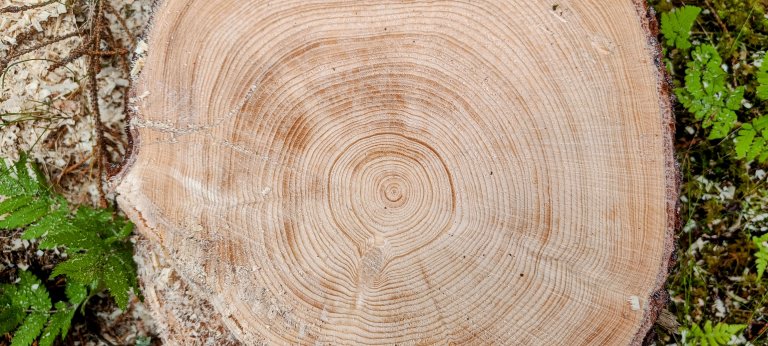
Timber density is affected by both temperature and age
“In general, a colder climate in Northern Norway causes the trees to grow less during late summer and autumn than in Southern Norway,” says Professor Geir Vestøl at NMBU.
Investigations performed during the 1980s found lower density and lower strength properties in spruce trees from Northern Norway, compared to those further south.
“Spruce trees in Northern Norway have, on average, somewhat lower density, but in certain areas the levels are comparable to those in the south,” Vestøl says.
Density and fibre length are crucial for strength. Previous research studies also show that both increase with the age of the tree.
“Narrower annual rings in the outer parts of the tree lead to increased strength and stiffness,” Vestøl explains.
And as the years pass, and the arctic spruce grows older and thicker, the added annual rings might also influence timber quality.
From pilot study to testing real sawn timber
A pilot study performed in 2022 provided the researchers with grounds for optimism. Both density and fibre length increased with tree age, potentially making the material more suitable for structural use. The researchers therefore proceeded with a full-scale study of sawn timber produced from northern Norwegian spruce.
In order to be used in construction, sawn timber must meet strict requirements for strength and stiffness, including parameters such as modulus of elasticity and bending strength.
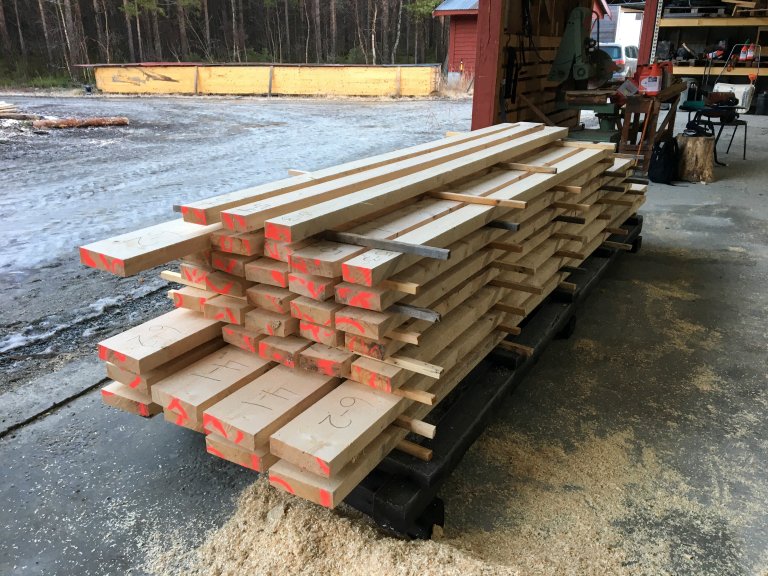
A total of 848 planks were tested, originating from nine different forest areas, ranging from 65 to almost 70 degrees north—from Hattfjelldal in the south to Lyngen in the north—as well as Lutz spruce from the coastal areas Lofoten and Vesterålen. The timber was sawn locally, then dried at Begna Bruk in Valdres in Southern Norway, before being tested at NMBU’s Wood Laboratory in Ås, south of Oslo.
Northern sawn timber meets quality requirements
The results show that density, stiffness—and partly the strength—of northern Norwegian planks is significantly higher than those found in studies from the 1980s.
“The improvement is likely due to the material being sourced from older forests, especially in Troms and Salten,” Vestøl explains.
Although the average values are still somewhat lower than for spruce from Southern Norway, Vestøl considers this to be within expected climatic differences.
However, there is no doubt in his mind that spruce sawn timber from Northern Norway meets the required standards.
“We have now tested real sawn timber, and we are pleased with the positive results. This is not just theory—northern Norwegian sawn timber is of good quality,” he says.
Summarized, the study shows that sawn timber of Norway spruce from Nordland and Troms graded as T1 meets the requirements for C18, T2 or better meets the requirements for C24, but T3 does not meet C30 requirements in all areas.
“In practice, this has little significance, since C24 is the most used class in the construction industry. C30 also requires machine strength grading,” Vestøl adds.
Spruce forests in Nordland—a growing resource
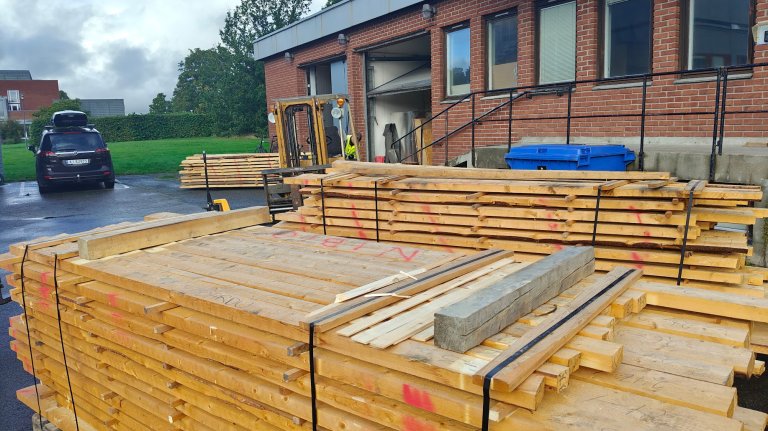
Nordland is Norway’s largest afforestation county. There is a strong focus on raising awareness among both forest owners and municipalities about the value of spruce.
Runa Stenhammer Aanerød, Senior Advisor at the Nordland County Governor, points out that forests in the north are less studied than those in the south, but that the potential is significant.
“Nordland’s spruce forest is a rapidly growing resource that could provide increased economic contributions to the forestry sector in the future,” she says.
The spruce forest must be actively managed
Back in Ås in Southern Norway, NIBIO’s Eirik Nordhagen emphasizes the long-term perspective. After World War II, major efforts were made in forest planting as a future resource for agriculture.
“Today, large quantities of spruce timber is available in Northern Norway. A resource that can be harvested and further processed,” he says.
He points out that growing conditions are good, and that climate change may further enhance growth.
“The results point in one direction: The quality of timber in the boreal coniferous forest is shaped over time through forest management and active use.”
At a time of increasingly uncertain global supply chains, this becomes even more relevant, he believes.
“Our northern forests are not a passive reserve that can easily be exploited during times of emergency. They must be actively managed if they are to function as a local and resilient source of renewable raw materials.”
Nordhagen also highlights the potential for local processing.
“Much of the timber can be used as sawlogs and further processed locally into building materials. But it is important that the forest is allowed to grow sufficiently before harvesting. That is when it can deliver the greatest value.”
He concludes:
“Let the forest mature properly. Then both the resource and the sawlogs can be processed locally. North-Norwegian spruce timber is a renewable resource that could play a major role in the construction industry in the north in the years ahead.”
Contacts

Eirik Nordhagen
Lead Engineer
-
Division of Forest and Forest Resources
(+47) 917 31 807 eirik.nordhagen@nibio.no Office Location: Ås H8
Gran i nord
The project “Gran i nord” (Spruce in the North) has aimed to document the strength properties of sawn timber from Northern Norway and contribute to increased knowledge of local wood resources for construction and other applications. The background for the project is a growing interest in sustainable materials and a need for better documentation of Northern Norwegian sawn timber. The project is intended to provide a foundation for further use, development, and local value creation based on forest resources in Northern Norway.
The work has been carried out in collaboration between industry, public administration, and research environments.
Spruce in Northern Norway
In 2024, there were about 24 million cubic metres of spruce standing on a total of 20,861 forest properties in Nordland, Troms, and Finnmark. Timber from Northern Norway accounts for only a small share of the total timber trade in Norway; most timber originates from Southern Norway, particularly Innlandet, Oslo, Viken, and Vestfold and Telemark.
Of the 9.4 million cubic metres of spruce harvested in 2025, about two million cubic metres came from the coastal counties and Trøndelag, while 209,000 cubic metres came from Northern Norway (Nordland and Troms). Source: Statistics Norway (SSB).
Contacts
Eirik Nordhagen
Lead Engineer
-
Division of Forest and Forest Resources
(+47) 917 31 807 eirik.nordhagen@nibio.no Office Location: Ås H8
Publications
Abstract
På 1900-tallet, og spesielt etter 1945, var det omfattende skogreising i Nord-Norge. Gran (Picea abies) var det mest vanlige treslaget å plante, men det ble også plantet andre arter, deriblant sitkagran (Picea sitchensis) og lutzgran (Picea x lutzii). Det er begrenset med undersøkelser av trelast av gran fra Nord-Norge, men en undersøkelse på 1980-tallet viste at trelasten hadde relativt svake styrkeegenskaper. Studier fra andre områder i Norge har vist at styrke og stivhet til konstruksjonsvirke blir bedre når trærne har høyere alder, og i dette prosjektet har vi studert trelast fra eldre bestand av gran i nord. I tillegg er det gjennomført en begrenset undersøkelse av trelast av lutzgran. Trelast av norsk gran ble samlet inn fra fire steder i Troms, fire steder i Salten og fire steder på Helgeland, og visuelt styrkesortert etter NS-INSTA 142 før densitet, e-modul og bøyefasthet ble testet i henhold til NS-EN 408. Tilsvarende undersøkelse ble gjennomført på trelast av lutzgran samlet inn fra tre steder i Lofoten og Vesterålen. Resultatene viste at gran fra Nord-Norge har høyere gjennomsnittlig densitet, e-modul og bøyefasthet enn det som ble funnet av Nagoda i 1985, og forskjellene er størst i Troms og Salten. Dette skyldes trolig at trærne i denne undersøkelsen er eldre, med mindre andel ungdomsved og smalere årringer, noe som gir høyere densitet og bedre mekaniske egenskaper. Sammenlignet med Sør-Norge er likevel gjennomsnittsverdiene lavere, noe som kan forklares med lavere temperatursum og dermed lavere densitet i nord. E-modul og bøyefasthet er positivt korrelert med densitet. Størst andel trelast havnet i sorteringsklasse T2 (51,1 %), mens T1 og T3 utgjorde henholdsvis 25,1 % og 21,8 %. Dette skiller resultatene fra studien til Nagoda, hvor det var en større andel i beste sorteringsklasse. Sorteringsutfallet er i stor grad avhengig av valg av prøvemateriale, og det er usikkert hvor representative materialene er for områdene. Gran sortert til T1 oppfyller kravene til fasthetsklasse C18. T2 eller T2 og bedre oppfyller kravene til C24. T3 oppfyller kravene til e-modul og bøyefasthet til C30, men ikke alltid kravet til densitet. Lutzgran hadde lavere gjennomsnittlig densitet enn gran fra Troms og Salten, men tilsvarende e-modul og bøyefasthet. Dette tyder på at lutzgran kan oppnå samme mekaniske egenskaper som gran, selv med raskere tilvekst og lavere densitet. Sorteringsutfallet for lutzgran viste høyere andel T1, lavere andel T3, og omtrent lik andel T2 sammenlignet med gran. Likevel oppnås tilsvarende mekaniske egenskaper, og Lutzgran sortert etter NS-INSTA-142 ser ut til å oppfylle kravene til fasthetsklassene som gjelder for sitkagran. Resultatene viste at sorteringsklasse T1 oppfyller kravene til C18 og sorteringsklasse T2 eller T2 og bedre oppfyller kravene til C24. Uttaket av lutzgran er begrenset til tre bestand i Lofoten og Vesterålen, og det bør testes trelast fra flere steder for å få et mer representativt materiale.