
Division of Environment and Natural Resources
ENGAGE: Europe Nutrient Management - Guided Approaches for Greater Export reduction

End: feb 2028
Start: feb 2025
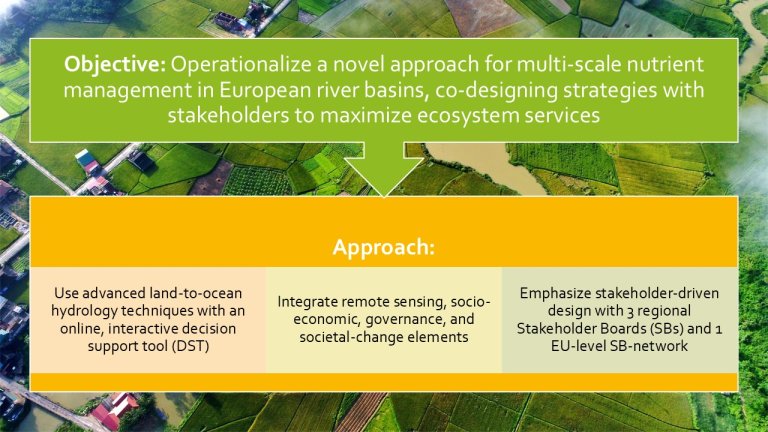
The mission of the ENGAGE Project is to operationalise an innovative vision for the future of multi-scale nutrient management in small to large river basins in Europe, to help relevant actors and stakeholders co-design management and development strategies.
More information
ENGAGE project website:Introduction to the ENGAGE project:
Case Studies within ENGAGE:
Full presentation - introduction to ENGAGE project:
ENGAGE presentation
| Status | NOT_TRANSLATED |
| Start - end date | 14.02.2025 - 13.02.2028 |
| Project manager | Jian Liu |
| Division | Division of Environment and Natural Resources |
| Department | Soil and Land Use |
| Total budget | 10 000 000NOK |
| Funding source | Water4All |
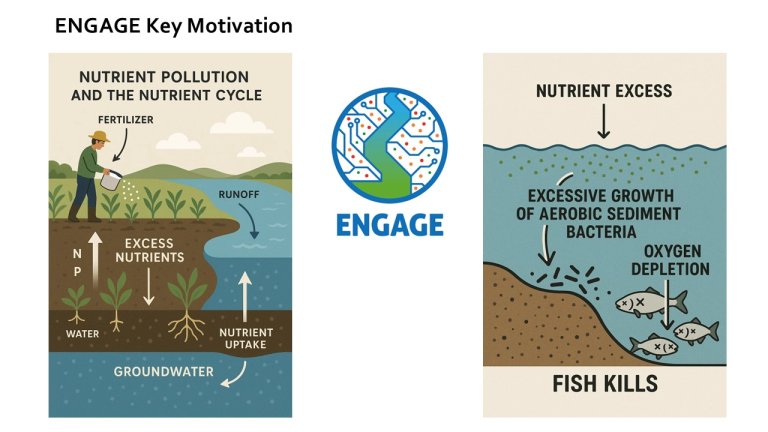
ENGAGE intends to provide a computational tool supporting pollutants management in large river basins, allowing for the definition and test of alternative scenarios, for which the tool will calculate scenarios at the water basin level. The project wants to contribute towards the maximization of provisioning ecosystem services, such as water supply and food, regulating ecosystem services, like water purification, supporting ecosystem services, e.g., nutrient cycling, and cultural ecosystem services, such as recreation.
To follow the updates and news from ENGAGE project you can visit us at:
- Facebook: https://www.facebook.com/EngageWater4All
- Instagram: https://www.instagram.com/engage_water4all/
- LinkedIn: https://www.linkedin.com/company/engage-water4all
NIBIO's role in ENGAGE project:
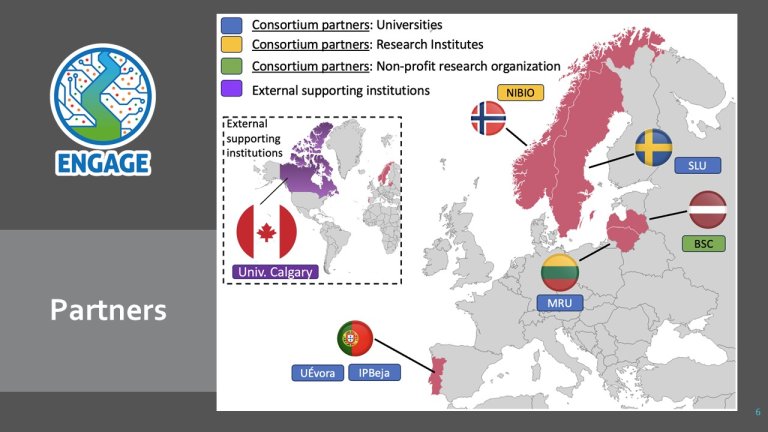
NIBIO is one of the 6 partners in the ENGAGE project. Our main responsiblities within the project are:
-
Leading of work within WP2: Co-design, knowledge transfer, and systems integration: aiming to engage a wide range of stakeholders in a collaborative process to co-design, develop, and evaluate effective, scalable nutrient management strategies across targeted European river basins. This process aims to foster knowledge transfer and ensure robust integration of solutions within an adaptable decision support tool (DST).
-
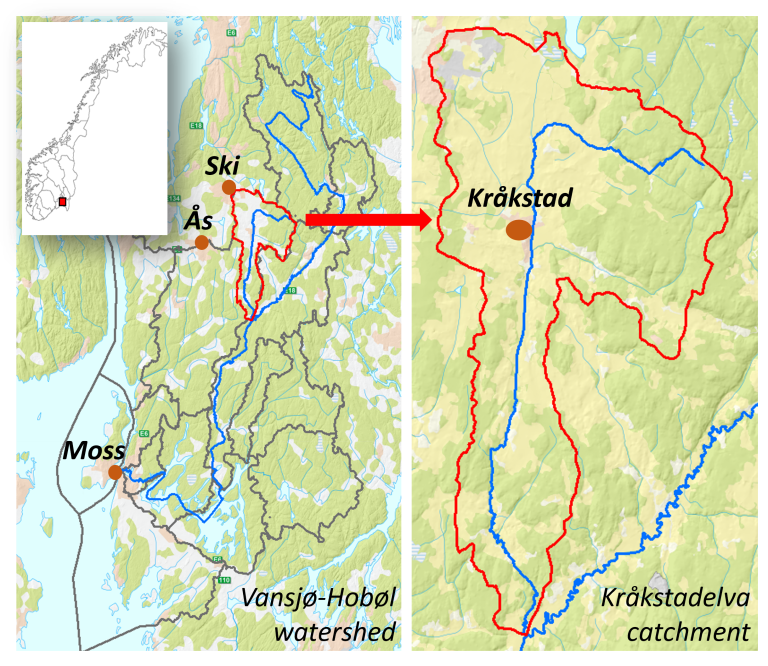
Norwegian case study - Kråkstadriver catchment: here we are building up on the experience, cooperation and hydrological modlining completed witihn OPTAIN project
Publications in the project
Abstract
Water quality degradation is a major issue in Mediterranean regions, but identifying the key natural and human drivers remains challenging, requiring large–scale studies for meaningful synthesis and comparison. This study analyzed a vast Mediterranean dataset spanning 89,015 across 15 Iberian river basins along a climate gradient (cooler-wetter north to warmer-drier south), 3 decades, 3441 stations, 19 parameters, and 15 million observations. It is the first study of this scale in the region, utilizing custom scripts for automated data compilation and processing. The study revealed an evident north–to–south water quality decline, with rising electric conductivity, pH, total suspended solids, nitrogen, phosphorus, organic carbon, and sulphate, alongside reduced dissolved oxygen and transparency. This pattern correlated with the latitudinal climate gradient and intensified agriculture in the south (Pearson correlation coefficient: 0.1 to 0.53; Spearman's rank correlation coefficient: 0.17 to 0.56), while increased forest cover had a mitigating effect (Pearson: −0.50 to −0.07; Spearman: −0.51 to −0.10). Multidecadal trend analysis revealed a shift around 2005 with most parameters decreasing, except for nitrate and phosphate, which rose likely due to the 2004/05 drought reducing river dilution and expanded irrigated agriculture, especially in Alentejo with the Alqueva reservoir. These findings are crucial for guiding future national management actions and pollution reduction initiatives in Mediterranean regions, aligning with the European Commission's “European Green Deal” that targets a 50 % reduction in nutrient losses to make agriculture more environmentally sustainable, and also provide a valuable reference to many other regions with similar challenges for water quality management.
Authors
Martin Volk Natasha Amorsi Sabina Bokal Natalja Cerkasova Rozalia Cvejic Csilla Farkas Benoît Fribourg-Blanc Petr Fucik Matjaz Glavan Luka Honzak Dominika Krzeminska Tatenda Lemann Federica Monaco Attila Nemes Ingrid Nesheim Mikolaj Piniewski Christoph Schürz Michael Strauch Brigitta Szabo Felix Witing Cordula WittekindAbstract
The increasing frequency of droughts and heavy rainfall is intensifying conflicts between agricultural water use and other human and environmental demands. Natural/Small Water Retention Measures (NSWRMs) can help mitigate these conflicts by enhancing water quality, improving agricultural resilience, and contributing to sustainable development goals. However, there are knowledge gaps about the effectiveness of these measures across different regions, scales, and climate conditions. The EU Horizon 2020 project OPTAIN aims to address these challenges in 14 European case studies. The project involves local stakeholders through Multi-Actor Reference Groups, which have identified and documented 235 potential NSWRMs, of which 66 from 29 categories have been selected for further evaluation. These measures are catalogued in collaboration with the WOCAT and NWRM.eu databases. To assess the impact of these NSWRMs at field and catchment scale, OPTAIN applies the SWAT+ model with a fully distributed routing scheme, accompanied by further field-scale simulations using SWAP in areas of high data availability. The project developed protocols and R scripts to standardize data preparation, model calibration, and evaluation across case studies, ensuring consistent analysis. Initial simulations in the German case study demonstrate positive effects of NSWRMs, such as low tillage and grassed waterways, in reducing peak water flows, increasing low flows, and enhancing nutrient and sediment retention. Furthermore, the project linked SWAT+ with an economic model using the CoMOLA platform to optimize NSWRM allocations based on environmental and economic criteria. Policy analysis is another important component of OPTAIN, with local and regional policies being reviewed to identify gaps and opportunities for harmonizing water and agricultural policies across Europe. Interim findings, shared through policy briefs, emphasize the need for better integration of agro-environmental policies, increased intersectoral collaboration, and awareness-raising among stakeholders. OPTAIN's overarching goal is to improve the acceptance and implementation of NSWRMs by harmonizing data, methods, and policies across the 14 case studies. While there are significant differences between countries, which pose challenges for comparative studies, the project is working to address these through data standardization and model improvements. The R scripts developed by the project will assist future SWAT+ users worldwide in setting up and calibrating models to evaluate the effectiveness of NSWRMs in water and nutrient retention. Ultimately, OPTAIN aims to optimize the spatial allocation and combination of NSWRMs, ensuring they are both environmentally and economically sustainable, while also promoting policy alignment at local, national, and EU levels.
Abstract
Reducing diffuse nutrient losses to water bodies remains a major problem in the agricultural areas of the Nordic countries. The transition towards a bioeconomy and ongoing climate change raise questions on the future of water quality and freshwater ecosystems and what kind of adaptation strategies could be implemented to maintain both food and environmental safety. The objective of our study was to evaluate the effectiveness of Natural Soil Water Retention Measures (NSWRMs) under current and future climate conditions in retaining water, soil particles and nutrients within the landscape. The hydro-biochemical model SWAT+ was implemented in the Kråkstad catchment in southern Norway using the novel approach developed within the EU H2020 project OPTAIN. This approach enables an improved spatial representation of NSWRMs in the landscape. Available discharge and water quality monitoring data were used as reference data for model calibration. The effectiveness of reduced tillage, grassed waterways, sedimentation ponds established in the forested areas and buffers on water retention and nutrient loads was evaluated. Our simulation results indicate that conservation tillage, which maintains stubble on the soil surface during winter, has the strongest impact on reducing soil and nutrient losses towards surface water bodies. Grassed waterways, established in existing erosion prone gullies, could also significantly contribute to water and nutrient retention within the landscape. The implemented NSWRMs did not appear to increase the soil moisture content in early spring even under future climate conditions, which is an important aspect for ensuring soil trafficability and the timing of sowing spring cereals.
Authors
Csilla Farkas Moritz Shore Agota Horel Agota Horel Gökhan Cüceloglu Dorota Mirosław-Świątek Maria Eliza TurekAbstract
Within the OPTAIN project, the effects of Natural/Small Water Retention Measures (NSWRMs) on water regime, soil erosion and nutrient transport are evaluated at both catchment- and field-scales for present and future climate conditions. The goal of this deliverable report D4.3 is to perform an integrated, model-based assessment of the effectiveness of NSWRMs at the field scale and to use these results for cross-validating the outputs obtained from the catchment-scale modelling. The assessment is based on the adaptation of a field-scale mathematical model (SWAP) to seven pilot sites across three European biogeographical regions and on combined analyses of NSWRM and projected climate scenarios. The scenarios are designed to evaluate the efficiency and potential of different NSWRMs in improving soil water retention and reducing flash floods and the loss of soil and nutrients under changing climate conditions. This report contains a detailed description of the SWAP modelling workflow, from input data preparation, model setup and harmonisation, model calibration and application in climate and NSWRM scenario runs. It presents calibration and NSWRM scenario results from seven OPTAIN case studies from three different biogeographical regions (Boreal, Continental and Pannonia). The report also describes i) the new approaches and tools developed within the OPTAIN project that facilitate the implementation of the scenarios and the interpretation of the modelling results, ii) the methods used to cross-validate the SWAP and SWAT+ models, and iii) the issues faced during the implementation of this work. The SWAP model was calibrated for all the pilot fields with good or satisfactory results. The impact of four in-field NSWRMs - reduced tillage, shifting to grassland, afforestation and drought tolerant crops - on the water balance elements was evaluated. The scenario results indicate that the effects of measures on soil water retention and other water balance elements have some regional pattern, but can be strongly dependent on local conditions (e.g. soil, crop, slope). According to the scenario results, for most of the cases the studied NSWRMs contributed to reducing evaporation, surface and subsurface runoff and percolation to deeper layers, which results in increased soil water retention or plant water uptake within the fields. The cross-validation of the field scale SWAP and catchment-scale SWAT+ models was a challenging task and could only be performed for selected water balance elements (evaporation, transpiration and drainage outflow). Comparable results were obtained in most of the cases for the baseline scenario, but the differences between the soil water balance elements simulated by the two models increased when implementing the different measures. The increased differences, however, could also reflect the differences in measure implementation, as these were constrained by the model’s structure and parameters. We concluded that the implementation of the SWAP field-scale model in the scenario analysis and cross-validation could positively contribute to i) better understanding the effects of NSWRMs at field level and ii) evaluating the outputs of the SWAP and SWAT+ models in a wider context. We concluded that NSWRMs can contribute to water retention within the landscape, and that this effect seems to decrease and increase in the future for measures related to management and land use change, respectively. The cross-validation of the water balance elements of the two models showed that the SWAP and SWAT+ simulation results were comparable for the status quo (present situation, for which the models have OPTAIN D4.3 Assessment of NSWRM effectiveness at field scale 6 / 143 been calibrated), but differed for the NSWRMs scenarios, depending on how the measures were implemented in the two models.
Abstract
Reducing diffuse nutrient losses to water bodies remains a major problem in the agricultural areas of the Nordic countries. The transition towards a bioeconomy and ongoing climate change raise questions on the future of water quality and freshwater ecosystems and what kind of adaptation strategies could be implemented to maintain both food and environmental safety. The objective of our study was to evaluate the effectiveness of Natural Soil Water Retention Measures (NSWRMs) under current and future climate conditions in retaining water, soil particles and nutrients within the landscape. The hydro-biochemical model SWAT+ was implemented in the Krakstad catchment in southern Norway using the novel approach developed within the EU H2020 project OPTAIN. This approach enables an improved spatial representation of NSWRMs in the landscape. Available discharge and water quality monitoring data were used as reference data for model calibration. The effectiveness of reduced tillage, grassed waterways, sedimentation ponds established in the forested areas and buffers on water retention and nutrient loads was evaluated. Our simulation results indicate that conservation tillage, which maintains stubble on the soil surface during winter, has the strongest impact on reducing soil and nutrient losses towards surface water bodies. Grassed waterways, established in existing erosion prone gullies, could also significantly contribute to water and nutrient retention within the landscape. The implemented NSWRMs did not appear to increase the soil moisture content in early spring even under future climate conditions, which is an important aspect for ensuring soil trafficability and the timing of sowing spring cereals
Authors
Csilla Farkas Moritz Shore Christoph Schürz Dominika Krzeminska Anne-Grete Buseth Blankenberg Robert Barneveld Attila Nemes Michael Strauch Felix Witing Martin VolkAbstract
No abstract has been registered
Authors
Ivana Korn Korg Ingrid Nesheim Marek Gielczewski Michael Strauch Dominika Krzeminska Anne Marie Eurie ForioAbstract
The OPTAIN case study teams met with stakeholder Multi-Actor Reference Groups (MARGs) for the third time to jointly discuss preliminary modelling results for specific Natural/Small Water Retention Measures (NSWRM) and obtain feedback. https://www.optain.eu/news/stakeholder-multi-actor-reference-groups-margs-met-3rd-time-jointly-discuss-preliminary
Authors
Štěpán Marval Petr Fučík Natalja Čerkasova Christoph Schürz Michael Strauch Felix Witing Mikolaj Piniewski Svajunas Plunge Csilla Farkas Dominika Krzeminska Sinja Weiland Tatenda LemannAbstract
The deliverable D2.3 of the OPTAIN project introduces a framework and scale specific guidelines for the parameterization of Natural/Small Water Retention Measures (NSWRM) in modelling approaches. More specifically, it provides a detailed translation of NSWRM into parameters and design approaches for the application in the SWAT+ (catchment scale) and SWAP (field-scale) models, which were selected as the main modelling tools in the OPTAIN project. This document can also be considered as an extension of the well-known Conservation Practice Modelling Guide for SWAT and APEX (Waidler et al., 2011), which is frequently used by the SWAT modelling community for testing the effectiveness of conservation practices. However, besides of conservation practices, the report focuses mainly on NSWRMs, and how they can be implemented in SWAT+, the new and restructured version of SWAT. Analogously, the NSWRM parameters are also described for the SWAP model, which is addressing the field-scale. Compared to previous NSWRM modelling approaches, this methodology enables the setting of NSWRM parameters in the two selected models to improve the description of the related hydrological and hydrochemical processes.