
Ryan Bright
Research Professor
Biography
Abstract
The top‐of‐atmosphere (TOA) albedo controls the amount of solar energy absorbed by Earth and is influenced by the reflectivity of both the atmosphere and surface. With considerable changes in land use over the past few decades it is reasonable to question whether a perturbed surface albedo has influenced TOA albedo over the corresponding period. Here, we identify regions for which surface albedo changes have been the dominant driver of TOA albedo trends from 2001 to 2020 and examine the degree to which this relates to changes in snow cover, surface soil moisture, and vegetation density and greenness. We show that land surface albedo changes have been the dominant driver of TOA albedo trends in 10.0% of the global land area, within which surface albedo decreases have led to increases in absorbed solar radiation of 0.737 ± 4.984 Wm −2 from 2001 to 2020. This corresponds to global change in absorbed solar radiation of 0.019 ± 0.812 Wm −2 , which is equivalent to approximately 7.0% of the radiative forcing from anthropogenic CO 2 emissions from 2011 to 2019 (IPCC, 2021, https://doi.org/10.1017/9781009157896.009 ). Net TOA darkening above tundra and deserts constitutes 38.6% and 21.4%, respectively, to the radiative feedback identified, whereas temperate biomes induced net TOA brightening, corresponding to 22.3%. Collectively, changes in snow cover, vegetation density and greenness, and surface soil moisture drive 68.5% of the surface albedo changes. The importance of surface albedo in explaining TOA albedo trends for parts of the globe highlights the relevance of land surface changes in understanding Earth's energy imbalance.
Abstract
No abstract has been registered
Abstract
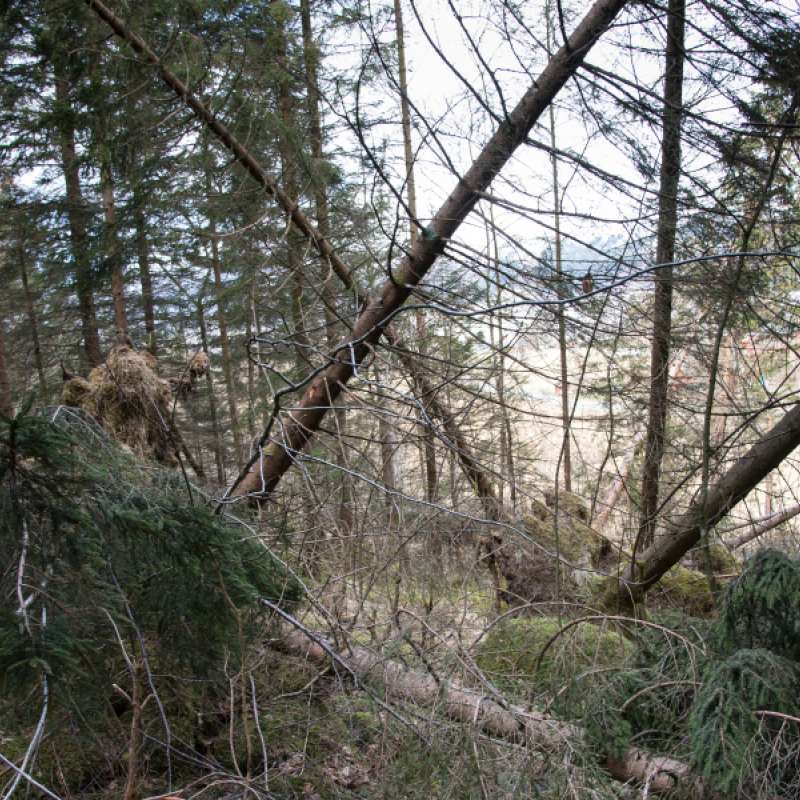
Forest transpiration is often quantified by scaling up stem sap flow measured on a few trees within a stand. This procedure carries uncertainty related to the (ill)representativeness of the sampled trees for the entire stand, often comprising several thousand transpiring trees. Here, we explored the uncertainty reduction potential afforded by increasing the number of sampled trees within the stand – not by costly sap flow monitoring equipment – but by point dendrometers measuring sub-daily fluctuations in stem radii which partially correlate with xylem water movement (i.e., sap flow). Using measurements collected in a forest dominated by even-aged spruce trees over two growing seasons, we built an empirical model for estimating hourly sap flow from individual trees equipped with point dendrometers, then applied it to estimate the daily transpiration of the stand both with and without trees equipped with point dendrometers. We found that the expanded tree sample size reduced the uncertainty of the stand-level estimate by 31–37 %, suggesting that the benefit afforded by increasing the stand representativeness outweighed the cost of introducing modeling error. Given their relative simplicity and affordability, we encourage additional investigations into the use of point dendrometers for studying tree water relations and water consumption patterns of entire forested stands.
Division of Biotechnology and Plant Health
FORESIGHT: Forest opportunities, risks and ecosystem services in a changing climate in Norway
Forest ecosystems are increasingly under pressure from climate change, emerging pests and pathogens, and more frequent extreme weather events. When such disturbances occur simultaneously—or interact with one another—the risk of severe damage can increase substantially. The FORESIGHT project aims to understand these complex, interacting challenges and to translate this knowledge into practical applications.