Anne Friederike Borchert
Research Scientist
(+47) 412 10 568
anne.borchert@nibio.no
Place
Landvik
Visiting address
Reddalsveien 215, 4886 Grimstad
Abstract
Jordens fysiske egenskaper ble studert på to golfbaner der enten små, lette robotklippere eller store, tunge tradisjonelle gressklippere hadde vært brukt i fire til fem år. På begge banene var jorda mindre komprimert der det var brukt robotklippere sammenlignet med der de store maskinene var brukt, men fordi innledende målinger manglet, kan det ikke konkluderes definitivt om forskjellene skyldtes bruk av robotklippere eller tradisjonelle gressklippere.
Authors
Karin Juul Hesselsøe Anne Friederike Borchert Trond Olav Pettersen Kristoffer Herland Hellton Trygve S. AamlidAbstract
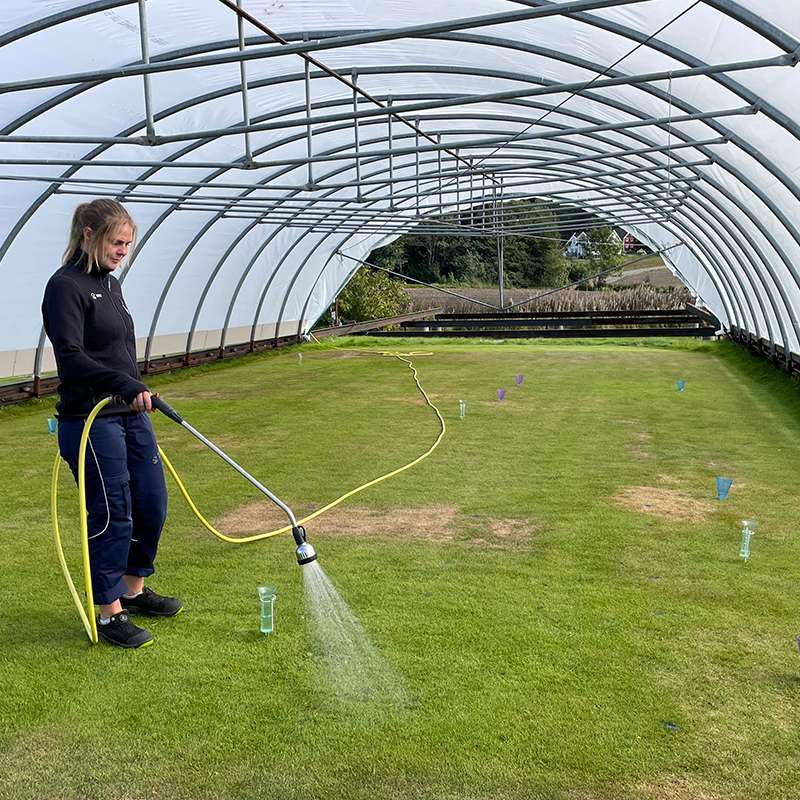
Abstract Ice encasement (IE) is one of the big challenges in winter stress management on golf course putting greens in Northern Scandinavia. The turfgrass is damaged due to lack of oxygen (hypoxia or anoxia) and accumulation of toxic by‐products of anaerobic respiration. Breeding IE‐tolerant turfgrass species and varieties is the best defense against these challenges. A method to simulate ice encasement was tested to screen selected varieties of winter‐hardy bentgrass species and red fescue subspecies. Note that 32 varieties were chosen from the SCANGREEN trial seeded at NIBIO Landvik, Norway, in 2019. Samples were taken in December 2020, 2021, and 2022, vacuum sealed in plastic, and stored in darkness at 0.5°C for up to 77 days to test them for their tolerance to simulated ice encasement (SIE). Samples were incubated at different intervals; plants were potted, and tiller survival was tested after 4 weeks of regrowth. Lethal duration of ice encasement (LD 50 ) that is, the number of days under anoxia that kills 50% of the plant population for each species and variety was calculated. The results showed that the ranking of cool season turfgrass species for tolerance to SIE was velvet bentgrass > Chewings fescue > slender creeping red fescue = colonial bentgrass > creeping bentgrass. This ranking does not fully reflect the ranking found in field tests where velvet bentgrass was superior together with creeping bentgrass. SIE caused a more rapid development of anoxia than IE in the field, and we hypothesize that creeping bentgrass is less tolerant to these conditions compared to the other species tested. To make the SIE method more representative for IE in field, it should be further adapted with incubation at lower temperatures, and with acclimation conditions to be standardized prior to sampling. Within species, the best tolerance to IE was found in velvet bentgrass Nordlys, creeping bentgrass Penncross, Chewings fescue Lykke, and slender creeping red fescue Cezanne.
Abstract
Abstract The primary benefits of turfgrass sod include rapid greenery and soil coverage, but its production causes concerns about soil losses at production sites. Soil adheres to the grass root system during harvesting and is removed from the sod farm, which in the long run might lead to soil degradation on the sod farm. In this study, we investigated sod thickness and the removal of organic and mineral matter when harvesting 24 fields representing 12 Norwegian sod farms in 2022 and 2023. On each field, 10 sod strips were randomly chosen, and five sod plugs were collected from each strip. Sod thickness was measured using a sliding gauge. Sod mineral matter (SMM: soil and thatch mineral matter) and sod organic matter (SOM: soil and thatch organic matter) contents were quantified by loss on ignition at 550°C. Management and field properties were also documented. Results showed an average amount of mineral matter in the sod strips of 36 Mg ha −1 for all fields but with significant variation among fields ( p < 0.001). The average SOM content was 10 Mg ha −1 . Mean sod thickness was 15.4 mm and had a strong correlation with SOM ( r = 0.8) but only a moderate correlation with SMM ( r = 0.6). Soil water content and surface hardness at harvest affected sod thickness and SMM only slightly. Sod harvesters with twin heads harvested significantly thicker sod strips and removed more mineral matter than harvesters with single cutting heads. Soil texture did not have a significant impact on sod thickness or mineral matter removal.