
Division of Environment and Natural Resources
Bio-based renewable Hydrogen from Agro/forestry/biogenic Residues through Advanced Technologies BHARAT-EU
End: jun 2030
Start: jul 2026
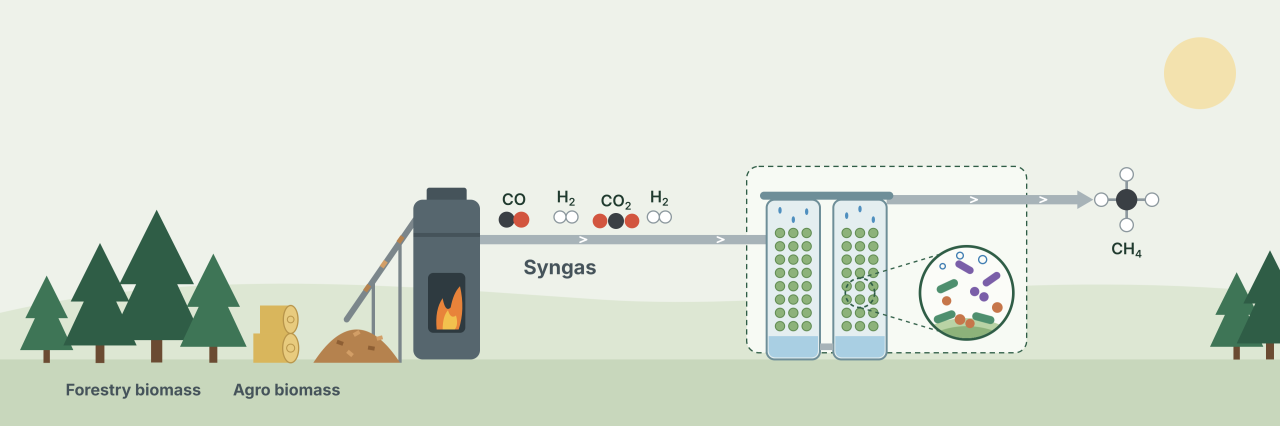
Turning biogenic waste into renewable hydrogen through advanced technologies: Leftovers from forestry and farming, like branches, wood chips and straw, contain a lot of energy. One way to use it is to heat the material with very little air. Instead of burning, it breaks down into a mixture of gases called syngas, made up mostly of carbon monoxide, hydrogen and carbon dioxide.

| External project link | Visit the official web site |
| Start - end date | 01.07.2026 - 30.06.2030 |
| Project manager at Nibio | Lu Feng |
| Division | Division of Environment and Natural Resources |
| Department | Bioresources and Recycling Technologies |
Syngas can’t be used directly as fuel for cars or put into the gas network. This is where microbes come in. Some tiny organisms, similar to those found in cow stomachs, marshes and biogas plants, can “eat” these gases and turn them into methane. Methane is the same gas as in natural gas, but here it comes from renewable sources. We call it biomethane.
Biomethane can be used to fuel buses and trucks, to heat buildings or in industry. It can also be stored and transported in the existing gas network.
Methane can also be made from syngas with chemical processes, but those need high temperatures, high pressure and very clean gas. The microbes work at moderate temperatures, around 60 °C, and are less sensitive to impurities in the gas. This could make it easier to produce renewable gas locally from residues.
The challenge is that these gases don’t mix easily with water, where the microbes live. At NIBIO we are testing reactors where the microbes grow as a thin layer on small carrier materials. The gas flows past them so they can “feed” more easily, which makes the process faster and more efficient.
NIBIO’s role in BHARAT-EU
BHARAT-EU (Bio-based renewable Hydrogen from Agro/forestry/biogenic Residues through Advanced Technologies) brings together partners from Europe and India to produce renewable fuels from waste and residues. NIBIO leads the work on the biological route. We are developing a process in which microbes convert syngas into biomethane, and we will build computer models of the process to understand and improve it. We will also help demonstrate the technology at a larger scale. Our work builds on NIBIO’s experience with biogas, bioeconomy and process development.